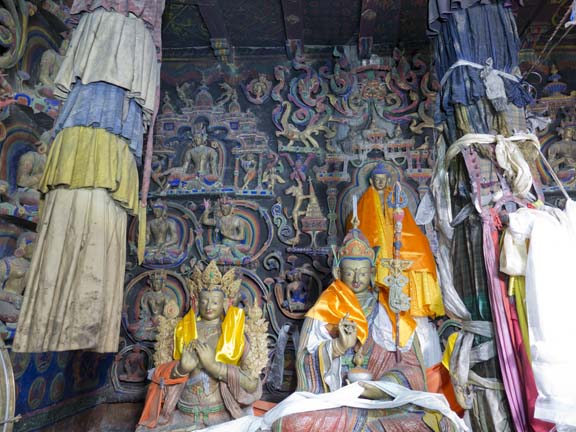
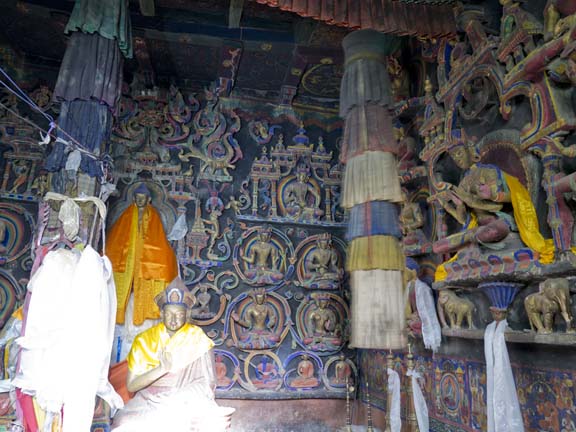
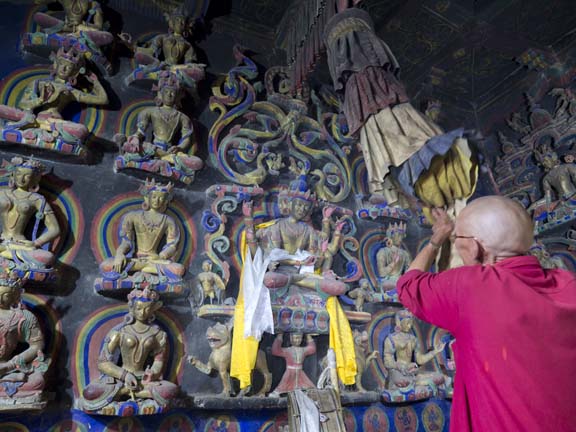
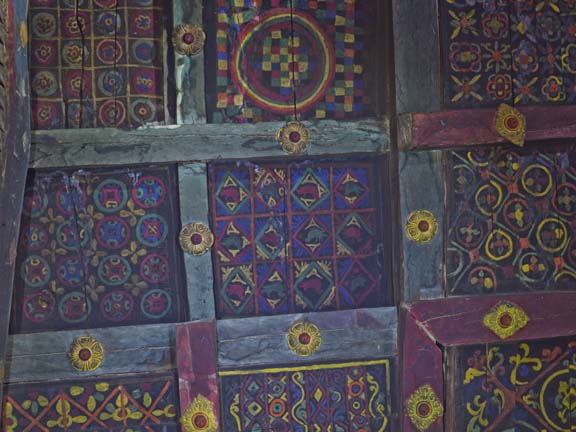
Gautama Buddha

Lahaul’s Trinity: Drilbu Ri, Phakpa, and Markul Devi

September 17th     Lahaul adventure continues…

The spiritual power of Lahaul, known as beloved Garsha Khandroling to Buddhists, lies in its sacred trinity of Drilbu Ri, Phakpa, and Markul Devi. These sites form the Three Vajras of right body, speech, and mind. The Three Vajra concept is akin to the Western religious concepts of righteous deed, word, and thought.

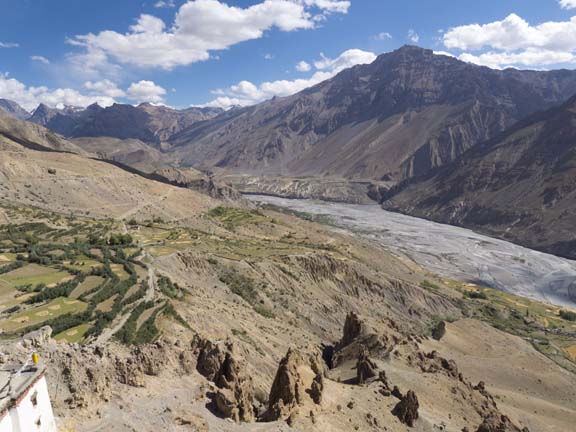
View of Chandrabhaga Valley en route to Triloknath, Lahaul
View of Chandrabhaga Valley en route to Triloknath, about one hour drive from Keylong, Lahaul

If you read my previous post, then you already know the experience at the summit of Drilbu Ri is sublime. This mountain is associated with Chakrasamvara, the enlightened body of Buddha. The other sites of the trinity are Phakpa Temple in Triloknath, associated with Avalokiteshvara and enlightened speech, and Markul Devi Temple in Udaipur, associated with Vajravarahi and enlightened mind. (By the way, this is Udaipur in the state of Himachal Pradesh, not the one in Rajasthan.)

After finishing the kora around Drilbu Ri, it seemed natural to visit the other two places, Triloknath and Udaipur, as a continuation of pilgrimage experience. Both are within an hour-and-a-half’s drive from Keylong, so that was my agenda for today! As with Dribu Ri, Hindus and Buddhists alike consider Phakpa and Markul Devi holy sites.
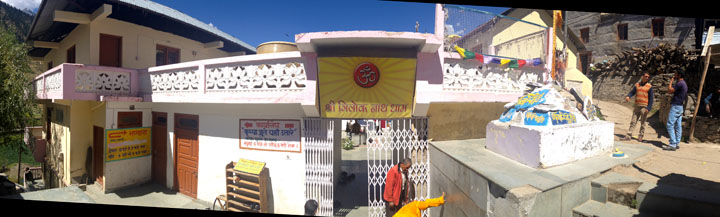
Phakpa temple of Triloknath, Lahaul, as seen from the exterior of its courtyard
Phakpa temple of Triloknath, Lahaul, as seen from the entrance to its courtyard
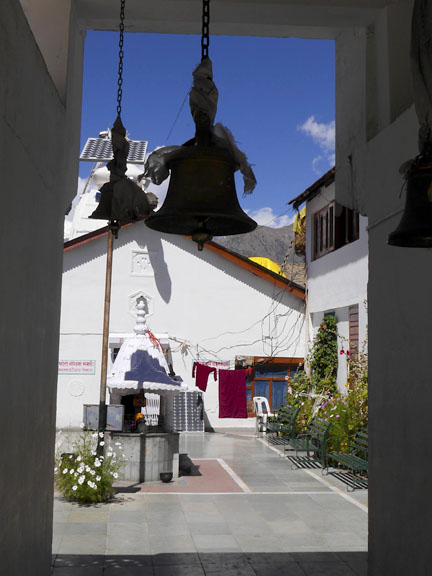
Entranceway to Phakba Temple, Triloknath, Lahaul
Entranceway to Phakba Temple, Triloknath, Lahaul. Visitors ring bells overhead.
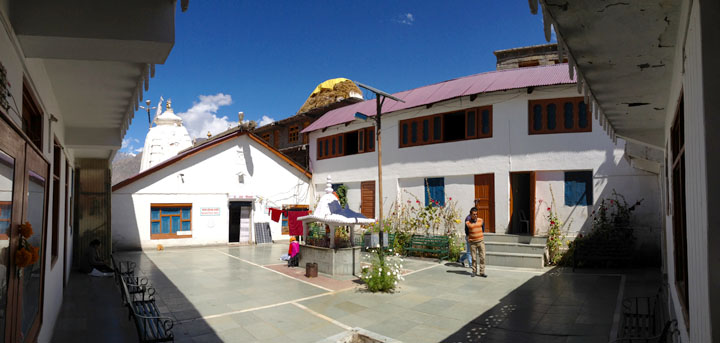
Inner courtyard of Phakpa. Triloknath, Lahaul
Inner courtyard of Phakpa. Not much can be seen of the original architecture at this ancient site. What exists now looks like contemporary vernacular. The building at left contains the inner sanctum and an interior circumambulatory

At Phakpa Temple, one can circumambulate the inner sanctum upon entering. The ample interior corridor contains Tibetan Buddhist mani prayer wheels one can spin for manifold blessings. Inside them are Avalokiteshvara’s six-syllabled mantra, Om Mani Padme Hum, the recitation of which is said to activate mental states conducive for peace and enlightenment.
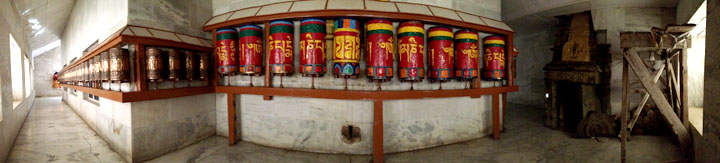
The interior circumambulatory, Phakpa Temple, Triloknath, Lahaul
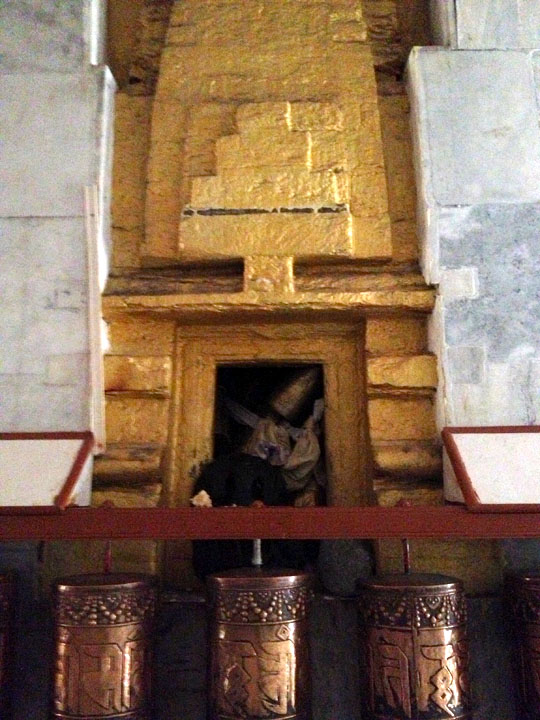
Gilded architectural detail that looks Hindu-influenced, Phakpa Temple, Triloknath

The inner sanctum contains a white marble statue of Avalokiteshvara, bodhisattva of great compassion, believed to be a miraculous self-arisen object found by a shepherd and installed in Triloknath. The statue is revered by Hindus as Shiva.
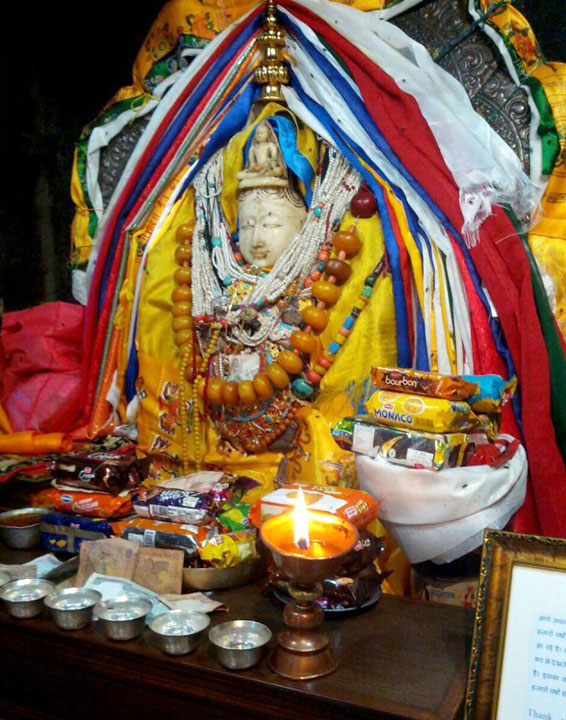
White marble statue of Avalokiteshvara, Phakpa Temple, Triloknath, Lahaul
White marble statue of Avalokiteshvara, Phakpa Temple, Triloknath, Lahaul, revered by Hindus as Lord Shiva. Photo: www.fpmt.org

Here is a view of it without ritual embellishments. This is a poster I photographed in the courtyard.
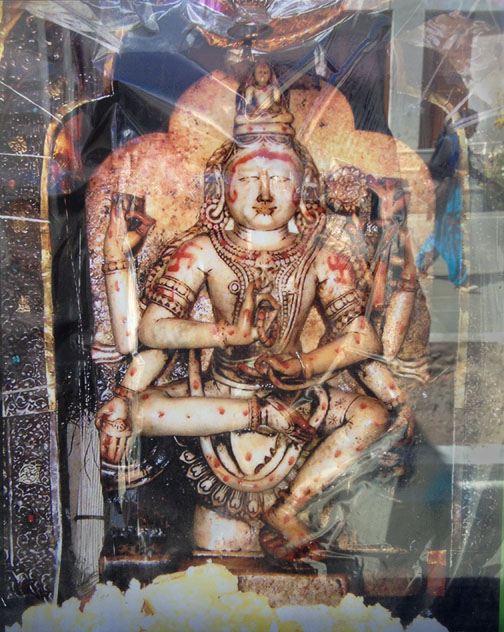
Avalokiteshvara statue at Phakpa Temple, Triloknath, Lahaul

The statue is a six-armed version of Avalokiteshvara. In Tibetan Buddhism, he is also popularly depicted with a thousand arms and eleven heads. This manifestation occurred when Amitabha Buddha, coming to the bodhisattva’s aid, split his head and arms so he could better hear, see, and help the suffering. The Dalai Lama is considered a human incarnation of Avalokiteshvara, or Chenrezig as he is known in Tibetan. 
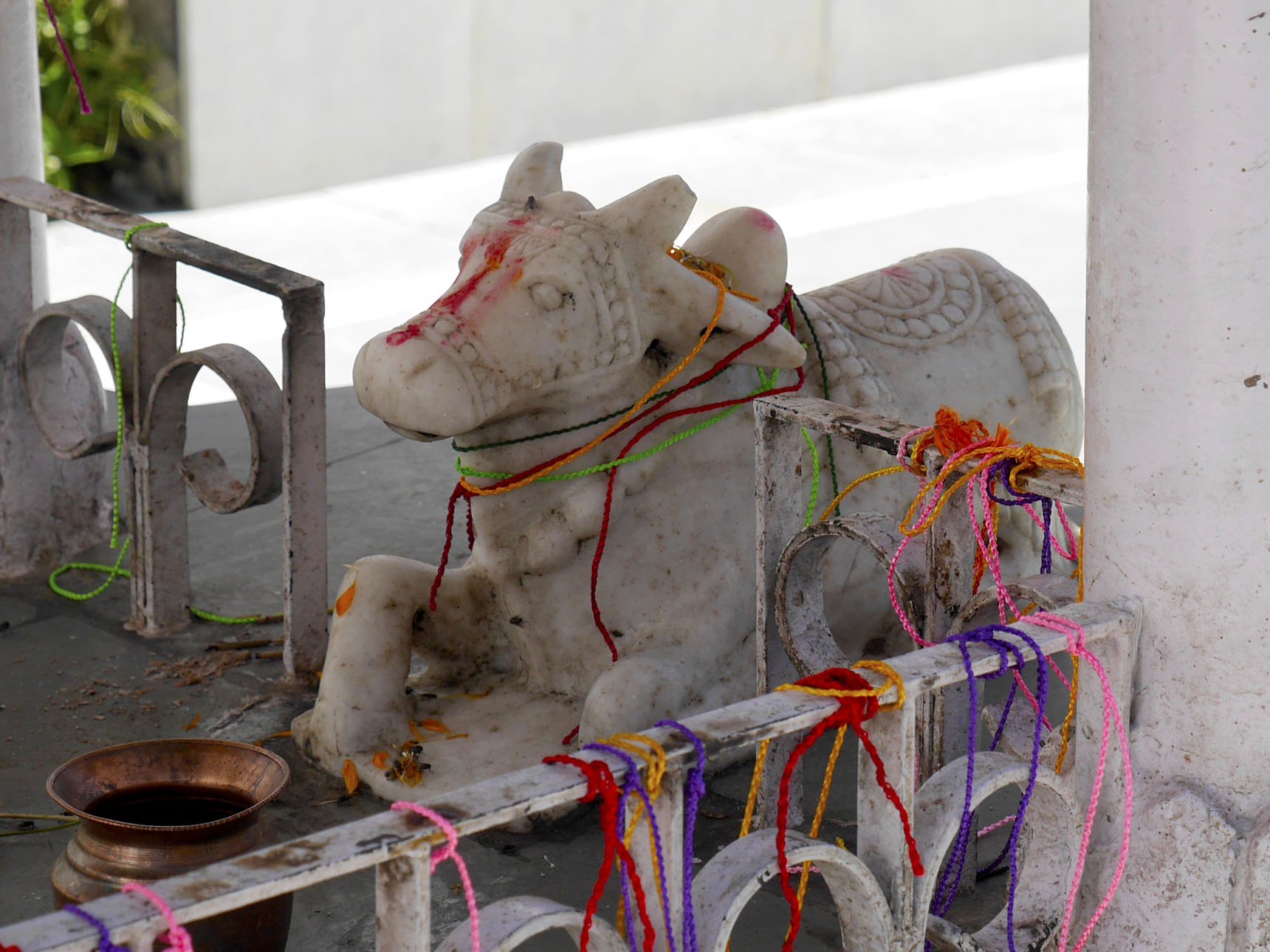
The cow is a sacred animal to Hindus, representing life and the sustenance of life. This sculpture is located in the center shrine of the courtyard at Phakpa Temple, Triloknath, Lahaul
Nandi – the cow is a sacred animal to Hindus, representing life and the sustenance of life. This sculpture is located in the center of exterior courtyard at Phakpa Temple, Triloknath, Lahaul

After Triloknath, I headed to nearby Udaipur to see Markul Devi Temple.
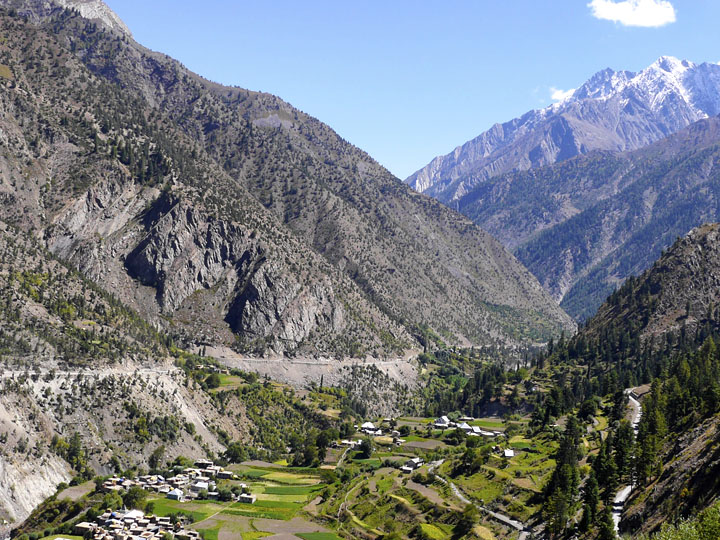
View of Himalayan Mountains on the way from Triloknath to Udaipur, Lahaul

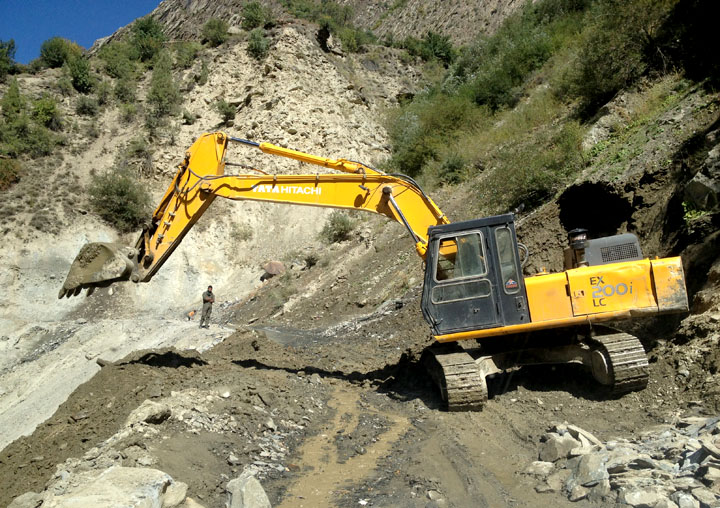
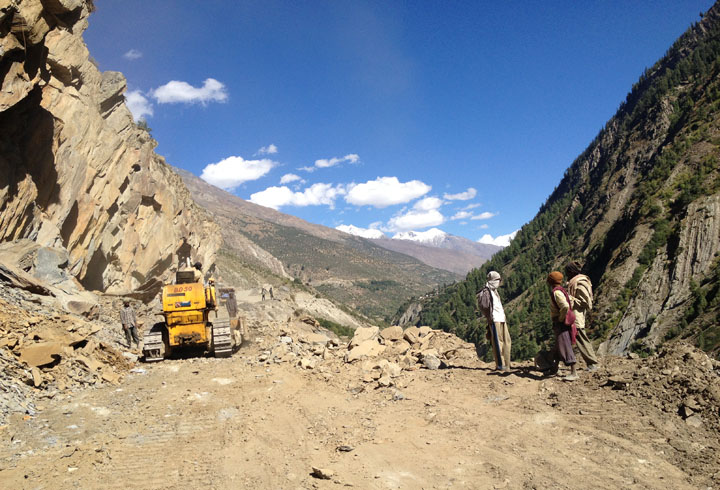
As was the case from Keylong to Triloknath, before long, we hit road construction again and were delayed because all traffic was halted. In this rugged terrain and climate, highways take a beating, and road maintenance and improvement is always happening. This one was a major operation, and not visible in the photo is a large crew of construction workers down the left side of the mountain where the dirt is being deposited.
en route Triloknath_72
Road construction en route to Triloknath, Lahaul
IMG_2934_72
Road construction en route to Udaipur, Lahaul

Often road workers are women with young children on their backs. Or sometimes the little ones keep themselves busy playing or sleeping on the construction site. I am not kidding! I have seen children sleeping hazardously close to the edge of a cliff, or running among machinery and equipment. So far, on my travels throughout Spiti and Lahaul, this is true everywhere. It is hard labor. Men and women break rocks by hand with hammers, dig mountainsides with pickaxes, haul dirt in baskets on their heads, and so forth. Driver D tells me most laborers are poor and come from Nepal, or are tribals from other states of India. As itinerant workers, they sleep in makeshift tents right there onsite for the season, until the cold weather comes and road work is halted.
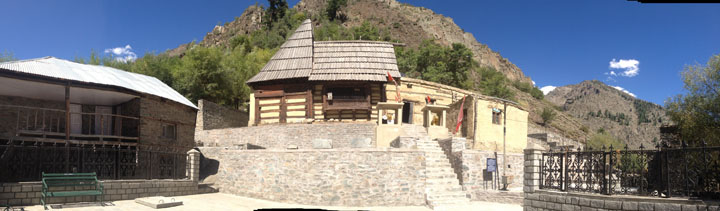
Markula Devi Temple, Udaipur, Lahaul

If you have been on an extended trip to see Indo-Tibetan Buddhist sacred sites in Spiti and Lahaul, what is immediately apparent about Markul Devi Temple is that it does not look at all like what you’ve seen elsewhere. Most of the structures I’ve seen from the same period, 11th-12th centuries, have been white-washed or painted mud and stone structures with flat roofs of the same materials, some perhaps thatched. Markul Devi is instead made from wood and stone with a highly pitched wood-shingled gable roof.
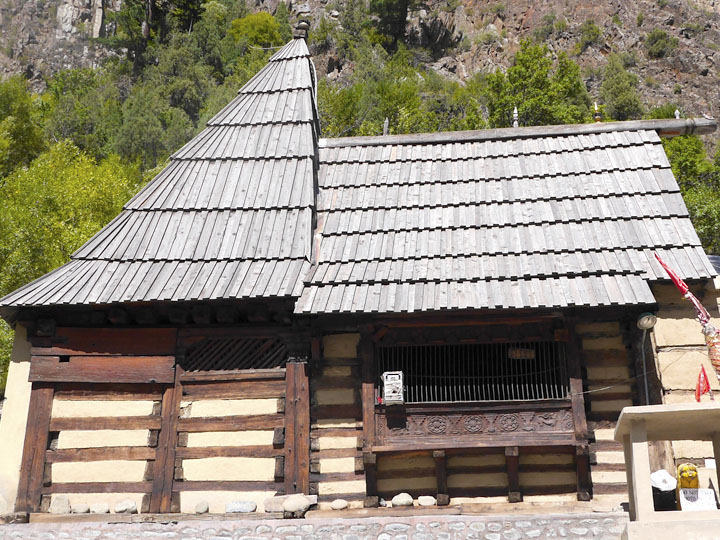
Markul Devi Temple, Udaipur, Lahaul
Markul Devi Temple exterior is an example of 8th century Kashmiri architecture in Udaipur, Lahaul

The Indian government traces its architectural style back to 8th century Kashmir, though the current structure is a reproduction from 11th century onward. It is protected by Archeological Survey of India, considered the last building of its kind to exist.
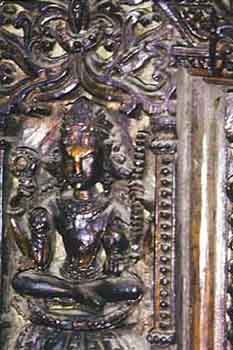
Wood carving from interior of Markul Devi Temple, Udaipur, Lahaul
Wood carving from interior of Markul Devi Temple, Udaipur, Lahaul. Photo: http://ignca.nic.in

The interior is also different from other Indo-Tibetan interiors I’ve seen. It is a stunning example of fine Indian woodwork. Massive and deeply carved single pieces of wood form nine elaborate ceiling panels. There are several ornate pillars and architraves, window panels, and the decorated facade of the inner sanctum. The fine carvings depict mainly Hindu subjects and figures, but there are also Buddhist references, such as the panel of Shakyamuni Buddha, and the scene with a three-headed Vishnu. The small shrine holding a silver statue of the Hindu goddess Kali is revered by Tibetans as Vajravarahi.

Shown at right is a detail of the wood carving possibly from the facade of the inner sanctum.

So there you have it…Lahaul’s trinity of Drilbu Ri (body), Phakpa (speech), and Markul Devi (mind)–revered by both Hindus and Buddhists. Implicit in their mutual respect for these places and their associated deities is their acceptance of each other’s pantheon. I admire this. An Indian acquaintance once said to me that he believes, ultimately, all gods are the same.

All photos © 2013, Eva Lee.

Guru Ghantal’s Unusual Mandalas and Hairy Mystery

Sept. 15, 2013     Lahauli adventure continues…

2_IMG_2739_yes_72
Guru Ghantal (Gandhola) Monastery on Drilbu Ri mountain slope, oldest existing monastery in Lahaul

Today was Guru Ghantal. Magnificent! Also known as Gandhola, it is the oldest of the existing monasteries in Lahaul with archeological evidence dating to 1st century C.E. What a place of tremendous significance for its location, history of great masters and activities, and having an ancient charnel ground considered one of the eight sacred ones in the Buddhist world. It is said that the unparalleled 2nd century C.E. Buddhist scholar and meditation master Nagarjuna, founder of Madhyamaka (“Middle Way”) school of thought and considered one of the most important philosophers second only to the historical Buddha himself, spent time in retreat here.

Guru Ghantal on Drilbu Ri mountain slope on upper left, as seen from across Bhaga Valley. Thupcholing Monastery is below on the plateau. The green roofs are retreat huts for practitioners, Lahaul
Guru Ghantal on Drilbu Ri mountain slope on upper left, as seen from across Bhaga Valley. Thupcholing Monastery which administers Gandhola is below on the plateau. The green roofs are retreat huts for practitioners. Below is Tandi bridge which crosses the Bhaga River where it joins the Chandra River, Lahaul.

Driver D dropped me off, and after ensuring that the nearby Thupcholing Monastery monk who is associated with Guru Ghantal was going to take the hike up with me, he waited at the bottom rather than accompany us. It’s a pretty steep climb up overgrown paths and sandy trails. The young monk, of course, not only being young but not challenged by high altitude like I was, darted up and would wait patiently for me to catch up, meanwhile chatting about Sino-Indian relations and asking enthusiastically about Western thought. I thought to myself, a veritable 21st century monk right here before me!

On the hike up to Guru Ghantal Monastery with monk guide, Lahaul

Guru Ghantal’s namesake comes from another celebrated master named Drilbupa Guru Ghantapa. He hailed from Nalanda originally as a Brahmin prince who later became a Buddhist scholar monk, and then a yogi. He is revered for introducing a highest yoga tantra, Chakrasamvara, and for attaining full enlightenment by meditating on Drilbu Ri. This mountain also gained its name from him and has since been considered the sacred abode of the deity. Indeed there is little in Lahaul that does not owe its spiritual allegiance to Guru Ghantapa since the area is believed to be charged with the profoundness of his enlightenment and Chakrasamvara’s energy.

As for the monastery’s sacred location, it is not only situated on the slopes of Drilbu Ri, for centuries a pilgrimage site as important as Mount Kailash, it also overlooks the confluence of the mighty Bhaga and Chandra Rivers. Hindus and Buddhists alike consider this an auspicious, powerful junction physically and symbolically, a holy place to cremate the deceased and spread their ashes.

The sacred triangle formed by the confluence of Bhaga and Chandra Rivers, Lahaul
Gandhola as it looks today, in need of preservation, Lahaul
Gandhola as it is today, with corrugated tin roof and in need of preservation, Lahaul. Photo: Kishore Thukral

Today, Guru Ghantal is largely empty and needs preservation. In its heyday over the past millennium, the complex of hermitage, meditation caves, and stupas garnered the presence of great Indian and Tibetan masters such as the ones mentioned, as well as Gyalwa Gotsangpa (whose imprints in stone I’ve written about here) and the Siddha Orgyenpa. When Indian Buddhism declined in about the 13th century, Tibetan Buddhism of the Drukpa lineage continued to flourish here, with Gandhola as the central monastery in Lahaul.

Ground floor of main temple, Gandhola, Lahaul, India
Ground floor of main temple, Gandhola, with statues of Avalokiteshvara, Guru Rinpoche, Lama Temphel, Lahaul

In the latter half of the 19th century, Drukpa spiritual leaders of Bhutan sent Lama Tashi Temphel to Gandhola to guide and teach Lahaulis. He was not only an accomplished lama but he was an artist and physician as well. This brought about a revitalization, because at his leadership, monasteries were restored, rituals improved, and temples beautified with paintings he himself did or trained others to do.

Second floor of Gandhola where there are adjoining monks quarters, Lahaul
Second floor of Gandhola where there are adjoining monks quarters, the walls were likely painted with Buddhist imagery at one time but today are completely undecorated, Lahaul
Another view of second floor, Gandhola Monastery, Lahaul
View of third floor from second floor looking up into ornate coffered ceiling, Gandhola Monastery, Lahaul
Painted coffered ceiling, Gandhola Monastery, Lahaul
The painted coffered ceiling with unusual mandalas, Gandhola Monastery, Lahaul. Photo: Kishore Thukral

According to the book Garsha (see this post for further info), all the sacred deities, mandalas, and Drukpa lineage holders at Guru Ghantal were painted by Lama Tashi Temphel circa 1870.  He also painted images at Tayul around this time during its expansion. He built Thupcholing for novices, who would spend three years there before moving on to practice at Guru Ghantal or other monastery. All ancient statues that were originally at Gandhola now reside there.

Center of ceiling with what was likely Chakrasambava mandala, Guru Ghantal Monastery, Lahaul
Center of ceiling with what was likely Chakrasamvara mandala, Guru Ghantal Monastery, Lahaul

Upon reviewing recently with a geshe the photographs I took of the ceiling, he remarked that the mandalas were unusual. The center one, which is rather damaged, is very likely a Chakrasamvara mandala. He believes all smaller ones, though their designs are unconventional, are dakini mandalas.

Very likely a dakini mandala, unconventional design, Guru Ghantal Monastery, Lahaul

The ceiling designs all appear to have been painted on paper and then installed. Although there are signs of water damage and disintegration, the overall state is quite intact and still vibrant. The detailed scrollwork is particularly fine and delightfully detailed.

Very likely a dakini mandala, unconventional design, Guru Ghantal Monastery, Lahaul
Very likely a dakini mandala, unconventional design, Guru Ghantal Monastery, Lahaul. Of note in this one are the stupas at each of the four gateways which are not painted in conventional proportions.
Very likely a dakini mandala, unconventional design, Guru Ghantal Monastery, Lahaul
Very likely a dakini mandala, unconventional design, Guru Ghantal Monastery, Lahaul.
The mantra Om Mani Padme Hum, ceiling of Guru Ghantal Monastery, Lahaul

On the beams appear lineage masters.

Guru Ghantapa, from ceiling of Guru Ghantal Monastery, Lahaul
Drukpa lineage masters on beams of ceiling, Guru Ghantal Monastery, Lahaul

On the walls of the third floor are paintings of deities on canvas.

Panorama of third floor wall paintings, Guru Ghantal Monastery, Lahaul
Possibly Guhyasamaja, wall painting, Guru Ghantal Monastery, Lahaul
Yamantaka, wall painting, Gandhola Monastery, Lahaul
Chakrasamvara, wall painting, Gandhola Monastery, Lahaul, India
Marlug Hevajra. wall painting, Gandhola Monastery, Lahaul
Chakrasamvara, wall painting, Gandhola Monastery, Lahaul
Wall paintings on third floor of Guru Ghantal Monastery, Lahaul

As it turned out, my driver should have come up to see Gandhola. I saw a special thing in the gonkhang (chapel usually dedicated to guardian deities) off the main hall of the temple which D was interested in and had never seen.  It was dreadlocks of human hair that is supposed to be endowed with spiritual power.

Human hair hanging from beam of gonkhang, Guru Ghantal Monastery, Lahaual

According to legend, hundreds of years ago, a lama was sitting in retreat meditating in this prayer room when he was accosted by a spirit.  He managed to grab the spirit by the hair, and hence, this is the miraculous proof of it. D said that encounters with the hair can impart energies, positive or negative, depending on whether your heart is good or not. Gee, does it make a difference that I thought it was yak hair at first? But indeed on closer examination, it looked like human hair, which effects a weird feeling to see such a fetish of unknown origin and purpose.

I heard an alternative suggestion. In the 12th century, revered scholar Sakya Pandita was famous for defeating masters of other religions in debates. In those days, religious debates were taken very seriously. The loser had to adopt the victor’s religion, and in the case of the loser adopting Buddhism, s/he must cut their hair. The loser’s hair therefore symbolized victory for Buddhist philosophy and debate. Perhaps it’s possible that the hair at Guru Ghantal is related to such a debate outcome.

Gonkhang, Guru Ghantal Monastery, Lahaul

The gonkang also contained a standing chest that had two protector deity masks hidden inside. These are typically used in Tibetan Buddhist cham dances. Lama Temphel is credited with improving the cham dances of Shashur Monastery. These ritual are usually created through visionary means. Danced by monks, they are said to be able to transmit profound Buddhist states to the beholder because they are meditative performances.

View of Lahaul Valley from Guru Ghantal (Gandhola) Monastery, where its sacred charnel grounds--one of the eight in the Buddhist world--are marked by an ancient stupa, Lahaul.
View of Lahaul Valley from Guru Ghantal (Gandhola) Monastery, where its sacred charnel grounds–one of the eight in the Buddhist world–are marked by an ancient stupa, Lahaul.
Majestic view of Himalayan mountains on trail to Guru Ghantal Monastery, Lahaul, India
Majestic view of Himalayan mountains on hiking trail to Guru Ghantal Monastery, Lahaul
On trail up to Guru Ghantal (Gandhola) Monastery, Lahaul, India
On trail heading back down to the main road from Guru Ghantal (Gandhola) Monastery, Lahaul

So today, with all the photography done at the monasteries I intended to visit in Lahaul–Shashur, Tayul, Kardang, and Guru Ghantal–I arranged to do the Drilbu Ri kora with a guide. Yes, I’m going to do it! The Thupcholing monk told me that climbing Drilbu Ri is no steeper than climbing up to Gandhola, just that it’s much longer, of course. What he said, together with the fact that I’ve now down mini-treks all around Keylong getting to monasteries and the one from Kardang back to town, emboldened me to go for it!

After all, in Garsha there is more to be found in the space and landscape than there is in paintings, so I was told correctly, and now I know. Even though the monastic sites here date at least to the 10th century if not before, there are no Indo-Tibetan murals to be seen here as there were in Spiti. I was advised along the way that Lahaul is to be experienced physically as a sacred location. All right, then, so what better way than to do the pilgrimage circumambulation of Drilbu Ri mountain, right?

Drilbu Ri Mountain seen from across Bhaga Valley, easily identifiable by its seven peaks and the notch just to the right, where trail to its summit proceeds

All photos © 2013, Eva Lee.

Tabo Monastery and “The Forgotten Gods of Tibet”

In the book The Forgotten Gods of Tibet: Early Buddhist Art in the Western Himalayas,  published in 1997, authors Peter van Ham and Aglaja Stirn wrote about Tabo Monastery‘s Tsug Lhakhang: “Unfortunately many of the paintings, especially in the lower register, are badly damaged. In fact the northern wall has a large area where nothing except for the grey wall can be made out. Some of these gaps were painted over in recent times–enhancing the impression of the high artistic merit of the old paintings since these newer additions only show a mediocre level of execution.”

Perhaps this may be an example (see image below). Notice how the figure to the left of the central Buddha is stylistically so different from the one on the right. As a trained fine arts painter as well as decorative painter, I must agree with authors van Ham and Stirn.

Stylistic inconsistency in repainted figure on left, Tabo Monastery Tsug Lhakhang

This below example of stylistic continuity is what the above example should look like.

Stylistic continuity in these three figures, Tabo Monastery Tsug Lhakhang
Stylistic consistency in these three figures, Tabo Monastery Tsug Lhakhang

Here is a view of a comparable original painting on the left and the one in question on the right.  Stiff and simplistic in appearance, the repainted one bears little resemblance to the refined and delightfully detailed original.

Example of original painting on left and repainted version on right, Tabo Monastery tsug Lhakhang
An example of original painting on left and repainted version on right, Tabo Monastery Tsug Lhakhang

Here, above the doorway, is another example of repainting in the chevron border and the two figures underneath.

inpainting_bkWall1
Repainted areas in Tabo Monastery Tsug Lhakhang

Presented above are only a couple of examples. In person onsite at Tabo’s Tsug Lhakhang, one finds upon scrutiny numerous incidences of such inpainting and overpainting. I fear that if this kind of “restoration” continues, over time, the temple’s extraordinary original murals will be obliterated rather than preserved. That would be an immeasurable loss for India, art history, and world posterity.

Experience the interior of Tabo Monastery’s Tsug Lhakhang by watching this video walk-through here.

Tabo Monastery – Tsug Lhakhang (Main Assembly Hall) from Eva Lee on Vimeo.

Tabo Monastery is under the protection of the Archeological Survey of India, but it is unclear to me who is doing the painting.

The book Architectural Heritage: Ladakh by The Indian National Trust for Art and Cultural Heritage, published in 2003, says it is often the monastics who do not realize the need for proper conservation, being more concerned with the religious content of the murals and not the art historical significance.

“In the great temples, the execution of wall paintings is carried out by monks and scholars whose canonical knowledge is profound…Most wall paintings are done on perishable mud plaster, and as these begin to disintegrate, these are either removed to draw fresh paintings or retraced and retouched to maintain their vibrancy and freshness. This way it is sometimes painful to witness a ruthless operation in which centuries old paintings are lost along with the structure by eager lamas to construct new structure and, consequently, draw another set of wall paintings…As soon as the walls begin to crack, or paintings fade, they are at once repainted.”

While it appears that at times the goals of Tabo Monastery and Archeological Survey of India may be at cross-purposes with one another, there seems to be great effort for mutual respect. After all, Tabo is a functioning Tibetan Buddhist religious site. At the same time, it is a rare Indo-Tibetan historical site under ASI’s charge. The question is, how are these two establishments proceeding forward?

Repainting, however, is only one of the man-made challenges to the preservation of Indo-Tibetan murals. There are also issues involving structural changes to historical buildings (see this earlier post regarding repairs to the roof of Tabo’s Great Assembly Hall), vandalism, and the effects of tourism, to name some others. Then there are the natural challenges such as wet conditions caused by snow or rainfall, and movement caused by earthquakes.

Partial repair and rudimentary inpainting in the Thousand Buddhas inner wall of Tabo Monastery Tsug Lhakhang inner sanctum, Spiti, India
Partial repair and rudimentary inpainting in the Thousand Buddhas inner wall of
Tabo Monastery Tsug Lhakhang inner sanctum, Spiti, India

I heard that it’s possible ASI may have applied for UNESCO World Heritage status for Tabo Monastery. In terms of conservation and preservation, this would be wonderful if it were to come about! I understand that the Ajanta Caves in Southern India, which contain stunning, well-preserved, ancient Buddhist paintings as old as 2nd century B.C.E., is a World Heritage site.

For further information about the Indo-Tibetan significance of this site, see Tabo Monastery: Vajradhatu Mandala Spendor.

All photos © 2013, Eva Lee.

Tabo Monastery: Vajradhatu Mandala Splendor

September 7th     Tabo Monastery Part Two…here it is!

Tabo Monastery Tsug Lhakhang, Spiti, India
Tabo Monastery Tsug Lhakhang, with meditation caves in the cliffs beyond, Spiti, India

Six-o’clock morning puja for the recently deceased beloved abbot at Tabo Monastery was quite beautiful. I wasn’t fully awake for it, and drifted through listening to each monk use his voice artfully to express himself through prayer. Very nice. I found out later from a lama that while they all learn the basic rhythm, it is up to each individual monk to say the prayer as he wishes. In other words, they all chant the same prayer, but some go out and come in on certain parts, using their voices to inflect sound, create variety, meld, or syncopate, etc.

Afterwards I was able to do some documenting at Tabo today! Limited time, however, permitted only doing the interior of the Tsug Lhakhang, the Great Assembly Hall. I was thrilled because it was the most significant temple in terms of its Vajradhatu mandala arrangement and my research project.

Experience the interior of Tabo Monastery’s Tsug Lhakhang  or Main Assembly Hall by watching this video walk-through.

Tabo Monastery – Tsug Lhakhang (Main Assembly Hall)

Entering the Great Assembly Hall, Tabo Monastery
Entering the Great Assembly Hall from its antechamber, Tabo Monastery

Wow, what a place! Dark and dramatic, with rays of light coming in through small ceiling windows, shining brilliantly on the main altar and then fading out towards the periphery of the assembly hall. I was stunned by the large number of statues and paintings to feast my eyes on! In a space that envelopes you in semi-darkness, it took some time to realize that just about every inch of wall and ceiling had been richly decorated.

See floor plan here.

With over a thousand years of continuous use as a meditation hall, I soaked in the sense of countless generations of monks who have spent their days here in peaceful meditation. I tried to fathom the devotion that Tabo’s Tsug Lhakhang has seen and sheltered. The overall impression is that of quiet yet teeming spiritual beauty.

Founded in 996 C.E. by the Guge (Western Tibet) king Yeshe O’d, the temple and statues are viewed clockwise in a Buddhist kora or circumambulation.

According to scholars, Kashmiri artists were responsible for the refined style of the statues and paintings. At the time, Buddhism had flourished in Kashmir and the region’s art was aesthetically sophisticated in expression and detail. Most of the art was executed circa 1042 C.E. during the renovation of the interior by Jangchub O’d, Yeshe O’d’s grand nephew.

The main altar features a gilded Vairocana. What a sight this tantric deity is with its larger-than-life four bodies, seated back to back, its serene faces looking out in the four cardinal directions. Distinctly Indian features include Indo-style trousers, painted red palms, procession carriage structure, and naga/garuda mount at top.

There are 32 multi-colored, graceful clay sculptures of Vairocana’s associated deities that line the assembly hall walls in Vajradhatu mandala order. Each is seated on a lotus pedestal, and cantilevers out of an attached sculpted halo background. Situated above eye-level, the figures look kindly and seem to lean towards you. Surrounding these deities on the wall are elaborate, colorful fresco paintings—scenes of Prince Sudhana’s pilgrimage and Buddha’s life on the lower frieze area; buddhas, bodhisattvas, other tantric deities and Bon goddesses in the upper area.

Clay statues of tantric deities, Tabo Monastery
Clay statues of tantric deities in Vajradhatu mandala arrangement, Tabo Monastery

Sudhana's pilgrimage depicted on lower frieze, Tabo Monastery Tsug Lhakhang
Sudhana’s pilgrimage on lower frieze, Tabo Monastery Tsug Lhakhang.  Much of it is too deteriorated to see clearly.

Painted buddhas and bodhisattvas on upper areas of TAbo Monastery Tsug Lhakhang
Guardian deity at far left, painted buddhas and bodhisattvas on upper areas of Tabo Monastery Tsug Lhakhang

Tabo Monastery Tsug Lhakhang altar, Spiti, India
Vairocana statue, main altar, Tabo Monastery Tsug Lhakhang, Spiti, India
Distinctly Indian features include Indo-style trousers, painted red palms, procession carriage structure, and naga/garuda mount at top.

Gilded Vairocana statue, Tabo Monastery Tsug Lhakhang altar, Spiti, India
View of gilded Vairocana statue from inner sanctum, Tabo Monastery Tsug Lhakhang, Spiti, India

Detail of gold Vairocana, Tabo Monastery Great Assembly Hall altar, Spiti, India

Tabo’s Main Assembly Hall, and in fact, the whole monastic complex was originally built according to a mandala concept as set forth by the Sarva-tathāgata-tattva-samgraha Tantrapractically a literal translation of it which distinguished this monastery. To the practitioner, therefore, Tabo’s interior and exterior order symbolized his sacred inner and outer realities. (More on this topic in previous post But Wait, A Bit About Mandalas.)

“The main temple, Tsug Lhakhang, was at the center of the whole complex.  The center of the temple was also the center of the compound along the east-west axis, having its major statue, Saravid Vairocana, placed in the central spot [now moved to the altar] not only of its surrounding 32 statues but also of the whole complex….Later additions have diluted the concept, but temples from Tabo’s heyday, together with stupas or chorten, form a simple but clearly visible mandala in the architectural layout-plan.” (The Forgotten Gods of Tibet: Early Buddhist Art in the Western Himalayas by Peter van Ham and Aglaja Stirn.  See also this book for excellent descriptions and further details on Tabo’s iconography)

Vajradhatu mandala arrangement of Vairocana and 32 associated deities, Tabo Monastery, Spiti, India.

Above is the floor plan of the Main Assembly Hall showing the Vajradhatu mandala arrangement of the Five Buddha Families: Vairocana, Amitabha, Amoghasiddhi, Akshobya, and Ratnasambhava, with their associated deities. These represent aspects of Buddha-nature that guide a practitioner to attain enlightenment according to the lower yoga tantras. Tibetan Buddhists today generally practice highest yoga tantra or Annutarayoga.

Vairocana, main altar, Tabo Monastery, Spiti, IndiaSide view of Vairocana statue, main altar, Tabo Monastery, Spiti, India.  The statue is built in the tradition of an Indian procession carriage, used for carrying the god around the temple or outside for blessing. 

For photography and viewing, I came prepared with flashlights. Thank goodness they were fully charged, and that our current guesthouse has power! We would not have been able to see most of these dark interiors without them.

Vajrahasa statue, Tabo Monastery
Vajrahasa statue, part of the Gem family of Ratnasambhava, Tabo Monastery

What a challenge it’s been to ensure my equipment is all charged and ready to go. Sadly, I am told by locals that Spiti in general lacks electricity because the Indian government is remiss in providing good infrastructure to all its citizens, and particularly to those communities that are remote, less populated, and lack political clout. As you can imagine this makes Spiti’s growing tourism especially difficult when hotel and restaurant owners, cyber cafes, etc., must routinely apologize to their clientele for not being able to meet their needs due to lack of power. I got creative with calculating how long my cell phone, laptop and camera equipment would last before finding the next feasible charging place.

Vajrakarma statue, Tabo Monastery Tsug Lhakhang
Vajrakarma statue, part of the Action family of Amoghasiddhi
Tabo Monastery Tsug Lhakhang

Vajrayaksa statue, Tabo Monastery Tsug Lhakhang
Vajrayaksa statue, part of the Action family of Amogasiddhi
Tabo Monastery Tsug Lhakhang

Akshobya statue,Tabo Monastery Tsug Lhakhang
Akshobya statue, Vajra family
Tabo Monastery Tsug Lhakhang

Behind the main altar is a small inner sanctum or cella that contains a 13th century statue of Amitabha in an elevated niche, flanked by two crowned statues of bodhisattvas, Padmapani on the left and Mahashtamaprapta on the right. Above him are figures identified as Apsaras or minor gods in the act of homage, and painted on his left and right are female attendants.

Amitbha statue, inner sanctum, Tabo Monastery Tsug Lhakhang
Amitabha statue, inner sanctum, Tabo Monastery Tsug Lhakhang
Stylistically different from the statues in the main hall, it looks like a later addition or replacement.

Mahasthanaprata statue, inner sanctum, Tabo Monastery Tsug Lhakhang
Padmapani statue, inner sanctum, Tabo Monastery Tsug Lhakhang. Visible on the left are some of the Thousand Buddhas that are painted on the circumambulatory inner walls.

Vajrapasa statue, Tabo Monastery Tsug Lhakhang
Vajrapasa statue guarding entrance to inner sanctum, Tabo Monastery Tsug Lhakhang

A narrow corridor for circumambulation surrounds Amitabha. Its inner walls are richly painted from floor to ceiling with Thousand Buddhas, manifestations of the enlightened one in splendid iteration of the five colors, different robes, lotus pedestals, and haloes.

Small buddhas on inner sanctum walls, Tabo Monastery Tsug Lhakhang
Buddhas in a Thousand Buddha depiction on inner sanctum circumambulatory walls, Tabo Monastery

On the outer walls are magnificent bodhisattvas and Supreme Buddhas (Tathagatas). These are my favorites! I really appreciate the mastery of these paintings in the inner sanctum. The below bodhisattva is an example of one of sixteen that symbolize aspects of Buddhahood stemming from Vairocana.

Bodhisattva, from outer circumambulatory wall of Tabo Monastery Tsug Lhakhang

The bodhisattva figures literally took my breath away when I saw them revealed by my flashlight! Every brushstroke showed ease, delicacy and variety in execution.  The highly inventive and detailed jewelry, as well as the fabric patterns, was a pleasure to discover. In addition, these paintings are well-preserved and dated 1042 C.E. when the temple was renovated. In other words, they appear as they were first created, untouched by other painters or conservators since then. What an incredible indication of the original quality of work that existed!

These inner sanctum figures look different from the ones on the upper register of the Tsug Lhakhang in that they are far more elaborate and refined. Additionally, Indo-Tibetan paintings show a freedom of composition not found in later Tibetan artworks where proportions and poses are more defined by convention.

The Supreme Buddhas were also delightfully painted, exhibiting a similar level of refinement and delicacy but painted at a much larger scale, about life-size.

Supreme Buddha, outer wall of circumambulatory, inner sanctum Tabo Monastery Tsug Lhakhang
Supreme Buddha dressed in unusual pleated robe, painted on outer wall of circumambulatory,
Tabo Monastery Tsug Lhakhang inner sanctum

I particularly like the sense of ease yet energy that this below Buddha expresses.  His face and gaze are sublime, his hands in graceful repose. But his unusual robe depicts rhythm and movement in the undulating sleeves and neckline detail. Coupled with the artist’s use of primary colors and radiating spirals in the halo, the overall effect of this painting is vibrant immediacy.

Supreme Buddha on outer wall, inner sanctum of Tabo Monastery Tsug Lhakhang

Detail of Supreme Buddha on outer wall, inner sanctum of Tabo Monastery Tsug Lhakhang

All photos © 2013, Eva Lee.

Dhangkar and Lhalung Monasteries in Spiti

Image
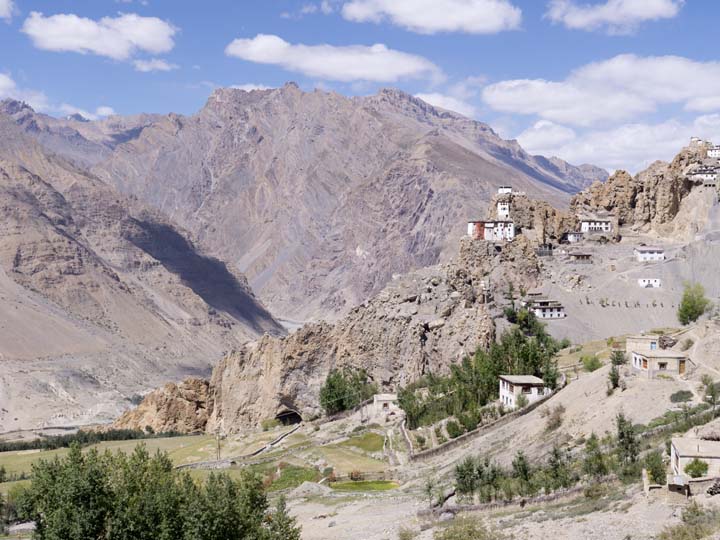
Dhangkar Monastery is seen on the ridge in the upper right. It consists of multi-storeyed buildings perched together, containing five different devotional halls.

September 4th

Our first day out to photograph was at Dhangkhar and Lhalung Monasteries. Both places granted permission because of local and monastic support. I was on my first documenting journey, and how positive an experience it was!

Dhangkar Monastery's Lha O-pa Gompa
Entering Dhangkar Monastery’s Lha O-pa Gompa.

Dhangkar Monastery
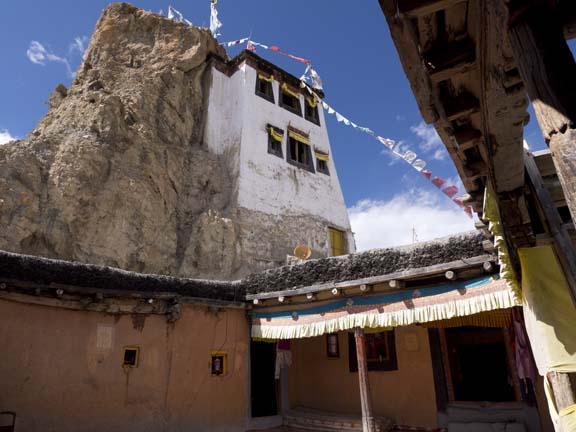
Dhangkar Monastery clings to its rocky outcrops. Shown here is the level in which the Dukhang and Lhakang Gongma may be accessed.

I’ll let the images speak for themselves, but it bears saying that Dhangkar was an original home of the ruling Spitian kings over a thousand years ago, built on a ridge and rock outcrop as a fortress. It clings to the mountain with its whitewashed buildings and traditional thatched roofs. Some buildings seem to be built one on top of the other.

Dhangkar Monastery narrow passageways

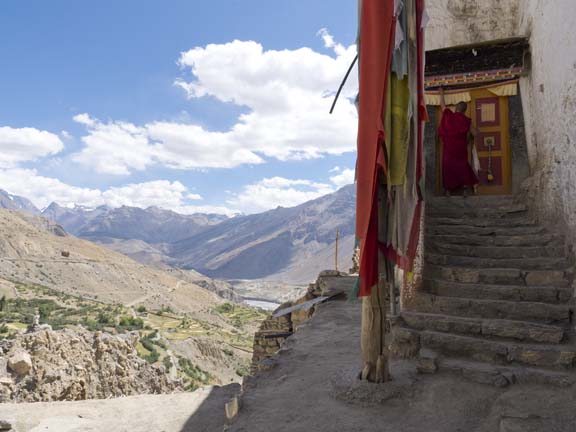
The interiors are navigated by narrow stairs (more like ladders, they’re so steep) and often low-ceilinged passageways. And when you scramble higher and higher, some stairs lead to the rooftops where you climb some more, on gravelly footpaths next to sheer cliff drops, in order to get into other adjacent buildings. Whenever you step outside, you are stunned by the incredible panorama of Spiti Valley in its splendor before you, dotted by the verdant, partitioned farmlands below, and the rigor of the sun casting impressive shadows across the mountain ridges.

View of Spiti Valley from rooftop of Lha O-pa Gompa, Dhangkar Monastery

Inside the Dukhang, which was the former assembly hall for monks before the new one was built a few years ago, sits a life-sized statue of Vajradhara, the “Diamond Being” who sees the ultimate nature of reality. One who does so is said to have wisdom, or right view.

Vajradhara statue, Dhangkar Monastery, Spiti

Kanjur Lhakang, library, Dhangkar Monastery

In the lower level Kanjur Lhakang (library containing Buddhist scriptures) are three wooden figures: Lama Chodrag, Shakyamuni, the historical Buddha, and Maitreya, the future Buddha. On the walls are faded and sooty murals, which one can barely see. It’s easy to understand from these murals alone why in 2006 Dhangkar Monastery was named by World Monuments Fund as one of the 100 most endangered sites in the world.

Kanjur Lhakang, library, Dhangkar Monastery
Kanjur Lhakang library of Buddhist scriptures, Dhangkar Monastery, Spiti, India

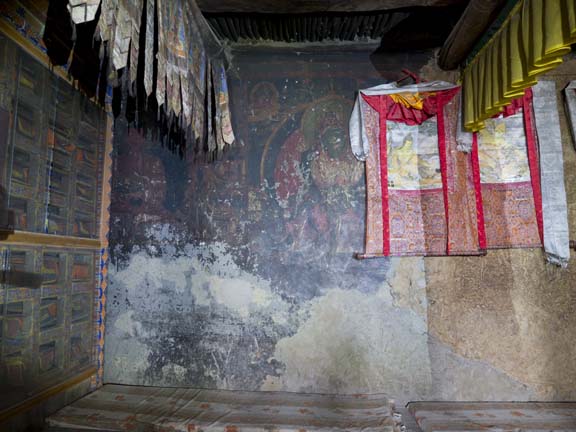
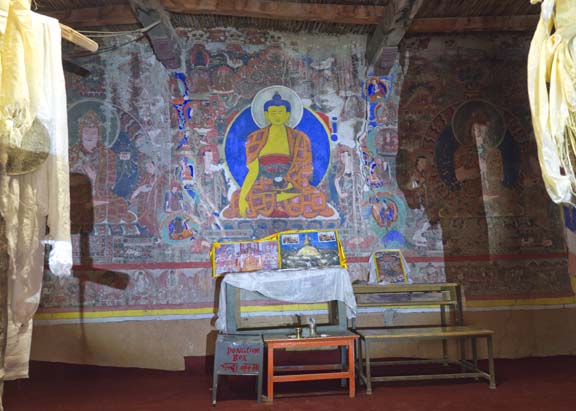
In the uppermost building of Lha O-pa Gompa is Lhakang Gongma, which has the most to see in terms of murals. Its central back wall dominates with Shakyamuni, Je Tsongkhapa (the reformer and Gelugpa founder of the 14th century), and Lama Chodrag.

Lhakang Gongma murals, Dhangkar Monastery
View of murals on the back central wall of Lhakang Gongma, Dhangkar Monastery, Spiti

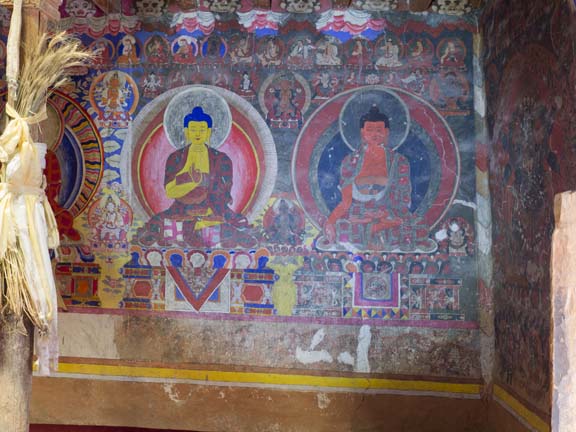
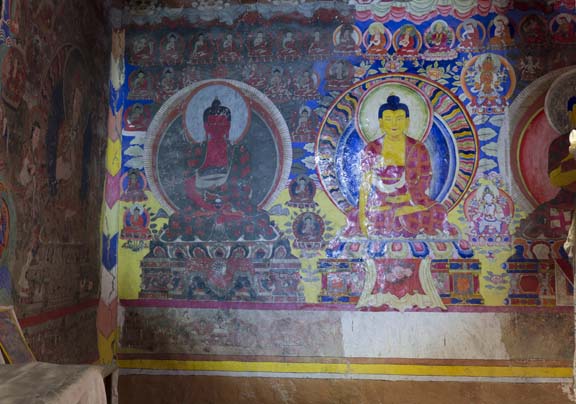
The adjacent walls depict various manifestations of Buddha. I was struck in general by how varied the paintings are in terms of color, style, and deterioration. It’s clear evidence of selective repainting over the centuries. In the back central wall, for example, Shakyamuni is obviously brighter and more saturated in color than the other two figures. According to Peter van Ham’s book, The Forgotten Gods of Tibet: Early Buddhist Art of the Western Himalayas, only a few of the paintings have been left untouched. The rest stylistically suggest a date of around 17th century.

Buddha murals, Lhakang Gongma, Dhankar Monastery
Buddha murals, Lhakang Gongma, Dhankar Monastery, Spiti

Buddha murals showing evidence of repainting over the centuries, Lhakang Gongma, Dharkar Monastery
Buddha murals showing evidence of repainting over the centuries, Lhakang Gongma, Dhangkar Monastery

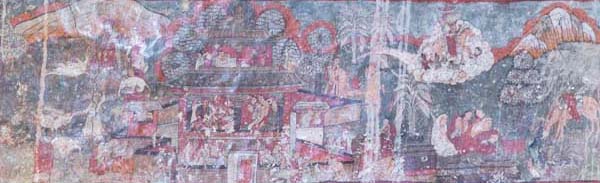
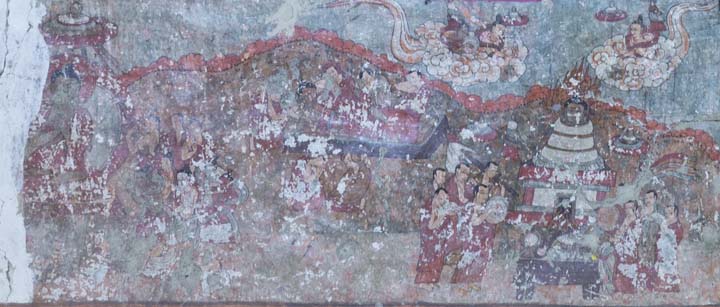
Of note in the murals is the frieze below the main figures, which largely depicts the life of Prince Siddartha, who became the historical Buddha, Shakyamuni. Tabo Monastery has a similar frieze in its Tsug Lhakang, the main assembly hall. Much of it is faded but the below two images are readily identifiable as the life of Siddartha at the palace of Kapilavastu, and the death of Buddha.

Dhangkar_Lhakang Gongma frieze
Life of Prince Siddartha at the palace of Kapilavastu, painted frieze at Lhakang Gongma, Dhangkar Monastery

Life of Prince Siddartha at the palace of Kapilavastu, painted frieze at Lhakang Gongma, Dhangkar Monastery
Death and cremation of Buddha, painted frieze at Lhakang Gongma, Dhangkar Monastery

We were told by locals that Dhangkar is older than the famous Tabo Monastery because, as the ancient home of indigenous kings, it contained a private temple from before the time of The Great Translator Rinchen Zangpo, pre-dating 10th century. Indeed, at the very top of the Dhangkar citadel are the remains of the palace, which you climb up to through a sleepy and steep quaint village that looks like it has maintained its same way of life for millenia.

Later in the day, we went to Lhalung Monastery. I really loved this small temple pictured below.

Lhalung Monastery, Spiti
Lhalung Monastery’s Serkhang or Golden Hall, Spiti

Lhalung Monastery, believed to be founded by The Great Translator Rinchen Zangpo, late 10th century C.E., was quite impressive. You enter through a narrow passageway to get to its Serkhang, which means literally House of Gold, but more often referred to as Golden Hall. Attached to its walls are sculptures of deities and other Buddhist personages. Three-dimensional figures in relief against the interior architecture of Buddhist temples are a distinctive feature of Indo-Tibetan artistry in Spiti and Ladakh areas. Similar ones are found at Tabo, Alchi, and Mangyu Monasteries.

Experience the rare and beautiful interior of Lhalung Monastery’s Serkhang by seeing a walk-through video here.

Entrance to Lhalung Monastery's Serkhang or Golden Hall
Entrance to Lhalung Monastery’s Serkhang or Golden Hall

Once inside, the splendor of the ornately gilded and polychromed clay figures strikes you. The sculptures fill the temple practically from floor to ceiling. There are over 51 figures mounted on the walls or placed in the temple, arranged in mandala formations on each wall. Geshe-la said that these types of cantilevered relief sculptures are specific to the Trans-Himalayan region and are not found in Buddhist temples anywhere else.

On the central wall is Shakyamuni in the middle, flanked by two elaborate groups of five figures, each dominated by a deity–identified as Dharmadhatu Vagishvara, a complex form of Manjushri on the left, and Vajrasattva on the right. These figures are set in architectural alcoves, while the others are contained within lotus motif scrollwork, accented by decorative animals and dancers.

Serkhang, Golden Hall, Lhalung Monastery
Maitreya, Guru Rinpoche, and Rinchen Zangpo (partly visible on right behind the column) form a trinity in the Serkhang altar of Lhalung Monastery, Spiti

Visible below is the right wall with sculptures arranged in a Prajnaparamita mandala, with Vairocana in the center surrounded by four Dyanibuddhas or Buddha-families: Ratnasambbhava, Akshobhya, Amoghasiddhi, and Amitabha, and their female attendants.

Serkhang, Lhalung Monastery, Spiti
Rinchen Zangpo statue among a pantheon of sculpted deities, Serkhang (Golden Hall), Lhalung Monastery

On the left wall (photo below) is a Vajradhatu mandala arrangement around the three-faced and eight-armed Saravid Vairocana. Around him are the 16 deities in his cycle, including once again the Buddha families of Ratnasambhava, Akshobya, Amitabha, and Amoghasiddhi.

Vajradhatu Mandala, Serkhang of Lhalung Monastery, Spiti
Left wall with Vajradhatu Mandala, Serkhang of Lhalung Monastery, Spiti

So now, that’s a lot of deities in one small temple! Their plethora really conveys not only aesthetic richness but also the complexity of Tibetan Buddhist tantric practice. What do all these deities represent in these mandala arrangements? Put simply, mandalas are visual guides for a practitioner in their meditation. They are aids in the realization of the true nature of mind and reality. As an oral and esoteric tradition, one needs a lineage teacher. Experiential understanding of this leads to liberation from conditioned existence–that is to say, leads to enlightenment or nirvana. Here is a succinct description of what the Five Buddha Families represent.

Geshe-la had said that the temples in these areas really demonstrate only the lower three tantras, not highest yoga tantra, which is mainly what Tibetan Buddhists practice today. The lower three are more concerned with purification, whereas the fourth level is actualizing self and deity, and therefore, enacting profound experience and understanding of emptiness. In The Great Translator Rinchen Zangpo’s time, late 10th century, focusing on the three lower tantras was a way to go back to roots and revitalize/reform tantric practice in Tibet which had grown distorted. This was partly the reason for the enormous interest in the original texts and their teachings, translating them from Sanskrit to Tibetan.

Lastly, the coffered ceilings were painted with delightful and folk-looking decorative motifs. Now I know what scholars mean when they speculate that these must reflect 10th century Kashmiri–influenced textiles.

Coffered ceiling of Serkhang, Lhalung Monastery, Spiti
Coffered ceiling of Serkhang, Lhalung Monastery, decorated with Kashmiri-influenced patterns that scholars believe reflect 10th century textile designs.

All photos © 2013, Eva Lee.


Bodhgaya & Terrorism

Statue of Buddha inside the Mahabodhi Temple, Bodhgaya, India

Bodhgaya and terrorism. I would never have put these two concepts together. That is, not until I heard about the bombings that occurred just a little over a week ago at this venerable holiest-of-the-holy site. The very place where Buddha became enlightened sitting under a bodhi tree. The place where thousands of pilgrims rich and poor alike travel to, to do full body prostrations, or make butter lamp offerings, meditate, circumambulate, chant songs and mantras, and other practices that cultivate one’s mind to turn towards wisdom, to enact compassion, to see the true nature of reality, the illusion of selfhood, amidst impermanence.

If you’ve ever been here, and experienced the electrifying devotion practitioners bring, you would be hard pressed to pair the scene with terror. It makes me feel sad for the perpetrators that they would harbor such contorted mentalities and ill plans among peaceful people.

Read some coverage of it here.

Fortunately, it seems there were no fatalities, and no serious structural damage done to the World Heritage site.

The Indian government today has however issued alert warnings for further possible terrorist strikes on Himachal Pradesh Buddhist monasteries.

This is discouraging and unwelcome news, to say the least, as I plan to travel to over a dozen such Himalayan sacred sites soon.