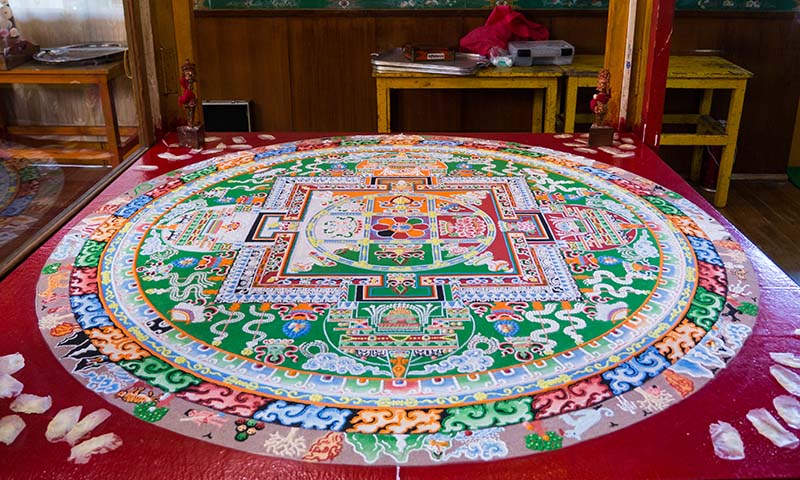
I’ve gone about it all backwards. Backwards in time, in pursuit of mandalas. It all started when I heard that a sand mandala was going to be made at Namgyal Monastery in Dharamsala, India, in 2010. So I went there, and found out that it was a Yamantaka mandala, part of a ten-day-long highest yoga tantra ritual which occurs annually at the Dalai Lama‘s personal monastery. My previous post here describes what little I knew then as I observed and documented the creation and dissolution of it. The resultant film and photographs can be seen here.
When I came back to the U.S., it was as if a floodgate had opened. I needed to learn more. No, not just more, but all I could about Tibetan mandalas–about their variety, their purpose, their history, the meditation practices they engendered, and so forth. What did it all really mean? What modern significance did it have?
My bookshelves began to fill up with writings about tantra and Buddhist philosophy, written by the first Tibetan teachers to venture into the Western world, post-1959 exodus from Tibet. Titles by the Dalai Lama, Chogyam Trungpa Rinpoche, Lama Thubten Yeshe, Dilgo Khentse Rinpoche, as a few examples, abounded. I also read works by contemporary lamas like Dzogchen Ponlop Rinpoche, Pema Choedron, Tsoknyi Rinpoche, Tenzin Palmo. Tibetan scholars and historians David Snellgrove, Robert Thurman, Deborah Klimburg-Salter, Martin Brauen, and others figured in there, too.
All this, in addition to my previous discoveries of well-respected meditation teachers from other Buddhist traditions–Sharon Salzberg, Joseph Goldstein, Jack Kornfeld, B. Allan Wallace. I followed the writing of neuroscientists and clinicians, too, who studied or used meditation in their work. They were also involved with fascinating Mind & Life Institute research or conferences–Richard Davidson, Jon Kabat-Zinn, Paul Ekman, Daniel Goleman.
It was a mindfulness-neuro-tantric-philoso-fest that poured forth!
Meanwhile, in 2011, the ritual experiences continued. I attended the Dalai Lama’s Kalachakra event for World Peace in Washington D.C., and witnessed the Kalachakra Mandala.
In 2012, I was at the Dalai Lama’s talk at Western Connecticut State University at which time I encountered a Compassion Mandala.
At both events, I had the wonderful opportunity of befriending and working with monks, nuns, plus other Buddhist practitioners and followers.
It was a steady flow. The waters at the floodgates just did not tire out. Answers came, and new questions arose.
Thus, on the heels of this, last year in 2013 I arrived back to India to experience and research rare Indo-Tibetan mandalas in Himalayan monasteries of Spiti, Lahaul, and Ladakh. How might they have evolved into Tibetan forms that we know today? What was this Indo-Tibetan 10th to 12th century period called the Second Great Transmission of Buddhism from India to Tibet? What did the sacred art look like? What did it mean?
At the end of my travels through the Himalayan high altitudes, I then thought, let’s reel back in time some more. What came before the Indo-Tibetan era?
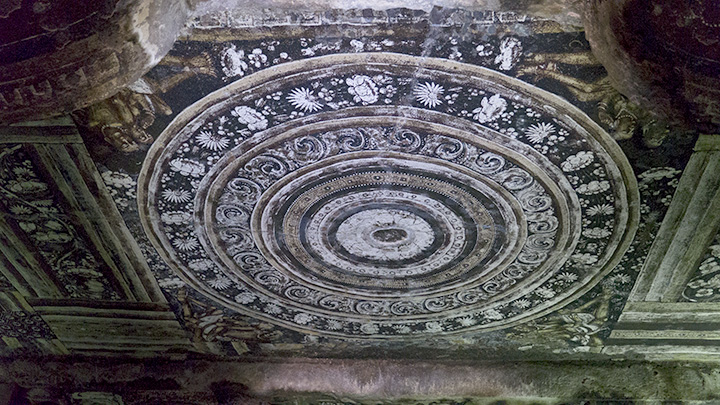
The answer was, Indian Buddhism, which could be seen at Ajanta and Ellora Caves where there are remains of elaborate 2nd to 8th century C.E. wall paintings, sculptures, and architecture. Such purely Indian Buddhist art is still preserved at these South Indian sites in the state of Maharashtra.
Finally, what might have come even before this in India? I mean in B.C.E. times. When I searched further, it seems that the Buddhist art historical record stops here. According to historians, not much still exists before the 1st century C.E. Little is known in India archeologically prior to this time.
So what’s it all about? Why would an artist go for all this? New artwork from my Fulbright experience does beckon me in the studio.
I guess I’m just driven by the big questions about mind and reality, which Buddhist philosophy seems to address best. And moreover, that largely works within a Western scientific paradigm. It doesn’t hurt, either, that an affable spiritual leader like the Dalai Lama continues to inspire and exemplify how one can be intellectually sharp, existentially awake, and compassionately engaged in the world. Despite being a keeper of complex Tibetan rituals and esoteric tantric teachings, he can still keep it simple and distill wisdom down to these words: “There is no need for temples, no need for complicated philosophies. My brain and my heart are my temples. My philosophy is kindness.”
Transitions Back to the U.S.
Posted
Gee, I’ve so far recounted only the September travels through Spiti, Lahaul, and Ladakh. There’s also October, November, and December to cover. Keeping this travelogue about my Fulbright experiences is taking longer than I anticipated! Editing photos (lots) and video (much) take time. So does research and writing.
And guess what? Now I have completed my Fulbright in India! Yes, that’s right, I’m back in the U.S.! It’s unbelievable how time flew by. I arrived just before Christmas holidays to rejoin family and friends, and rang in 2014 at home.
But, dear reader, there is much more to come. This blog is not over yet. After I finished traveling through the Himalayan high altitudes, I went to the lower altitude areas of Dharamsala, Bir, and Rewalsar (Tso Pema) to see the artwork of contemporary monasteries.
Plus, I also went to see the Buddhist carvings and frescoes of Ajanta, Ellora, and Aurangabad Caves in Southern India. These date from 2nd century B.C.E. to 8th century C.E., preceding the Indo-Tibetan period that I have been concentrating on in the Spiti, Lahaul, and Ladakh areas. After researching the sacred artwork of 10th century monasteries such as Tabo, Lamayuru, Lhalung, Mangyu, and Alchi, I felt compelled to see what came before.
Ajanta coming up next! Here is a sneak peak. I promise you’ll never think of the word “cave” the same way again!
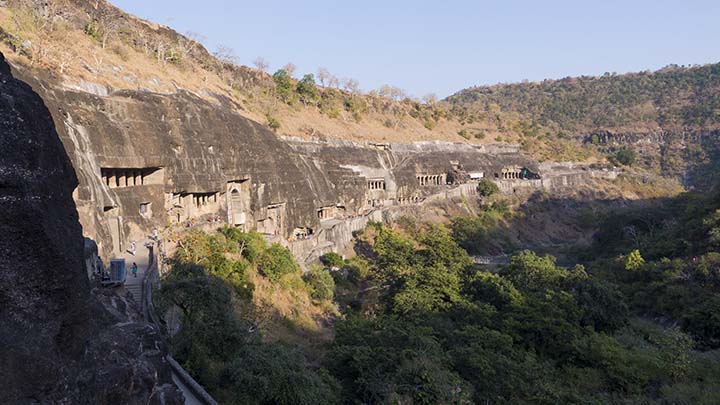
Ajanta Caves, a UNESCO World Heritage site located in a horse-shoe shaped river valley, approximately 30 elaborately carved and painted rock-cut caves dating circa 2nd century B.C.E to 480 or 650 C.E. Buddhist caves, near Aurangabad, IndiaAjanta Cave 26, a chaityahall with stupa, colonnade walkway, and carved relief sculptures. Seen on left wall is Buddha in his parinirvanapose, India
Lahaul’s Trinity: Drilbu Ri, Phakpa, and Markul Devi
Posted
September 17th Lahaul adventure continues…
The spiritual power of Lahaul, known as beloved Garsha Khandroling to Buddhists, lies in its sacred trinity of Drilbu Ri, Phakpa, and Markul Devi. These sites form the Three Vajras of right body, speech, and mind. The Three Vajra concept is akin to the Western religious concepts of righteous deed, word, and thought.
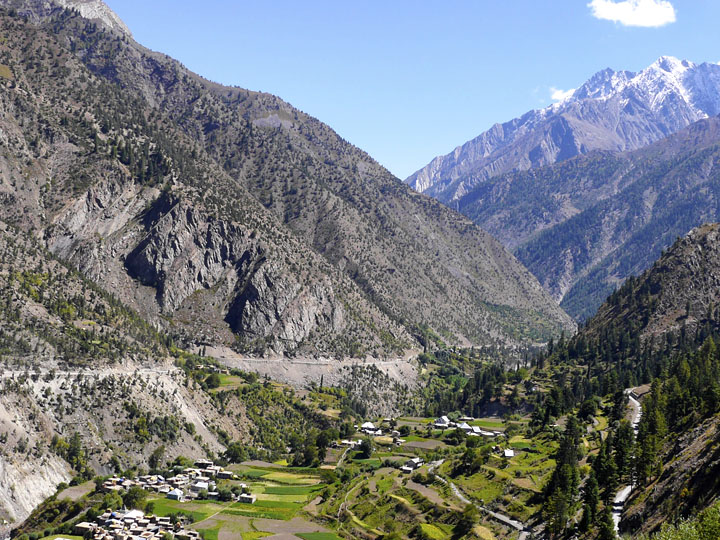
View of Chandrabhaga Valley en route to Triloknath, about one hour drive from Keylong, Lahaul
If you read my previous post, then you already know the experience at the summit of Drilbu Ri is sublime. This mountain is associated with Chakrasamvara, the enlightened body of Buddha. The other sites of the trinity are Phakpa Temple in Triloknath, associated with Avalokiteshvara and enlightened speech, and Markul Devi Temple in Udaipur, associated with Vajravarahi and enlightened mind. (By the way, this is Udaipur in the state of Himachal Pradesh, not the one in Rajasthan.)
After finishing the kora around Drilbu Ri, it seemed natural to visit the other two places, Triloknath and Udaipur, as a continuation of pilgrimage experience. Both are within an hour-and-a-half’s drive from Keylong, so that was my agenda for today! As with Dribu Ri, Hindus and Buddhists alike consider Phakpa and Markul Devi holy sites.
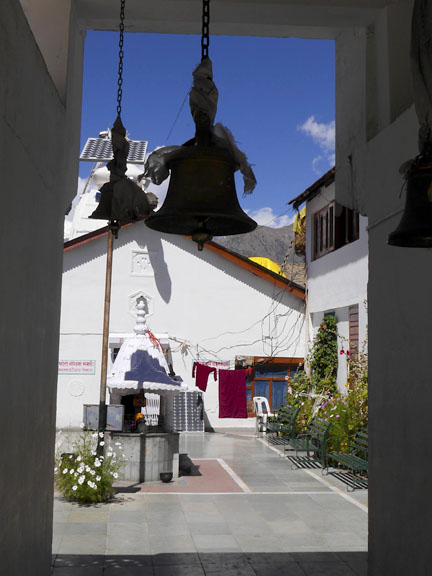
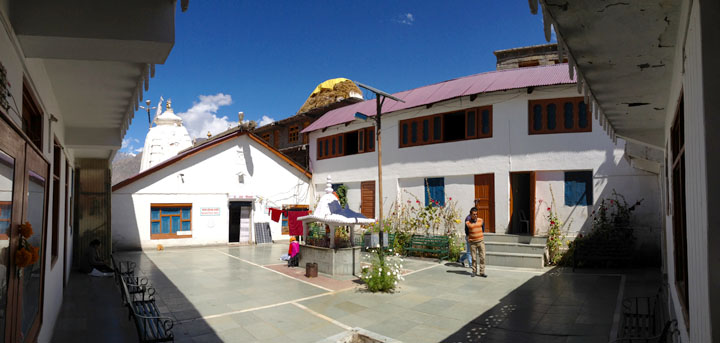
Phakpa temple of Triloknath, Lahaul, as seen from the entrance to its courtyardEntranceway to Phakba Temple, Triloknath, Lahaul. Visitors ring bells overhead.Inner courtyard of Phakpa. Not much can be seen of the original architecture at this ancient site. What exists now looks like contemporary vernacular. The building at left contains the inner sanctum and an interior circumambulatory
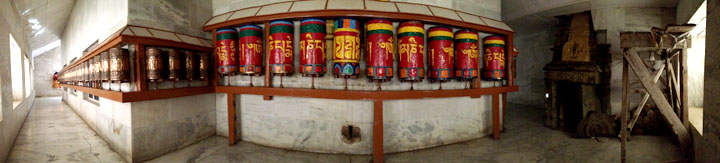
At Phakpa Temple, one can circumambulate the inner sanctum upon entering. The ample interior corridor contains Tibetan Buddhist mani prayer wheels one can spin for manifold blessings. Inside them are Avalokiteshvara’s six-syllabled mantra, Om Mani Padme Hum, the recitation of which is said to activate mental states conducive for peace and enlightenment.
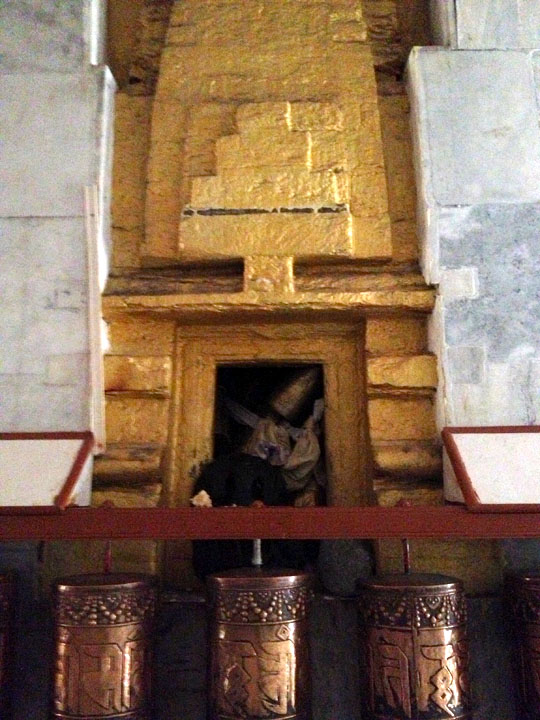
The interior circumambulatory, Phakpa Temple, Triloknath, LahaulGilded architectural detail that looks Hindu-influenced, Phakpa Temple, Triloknath
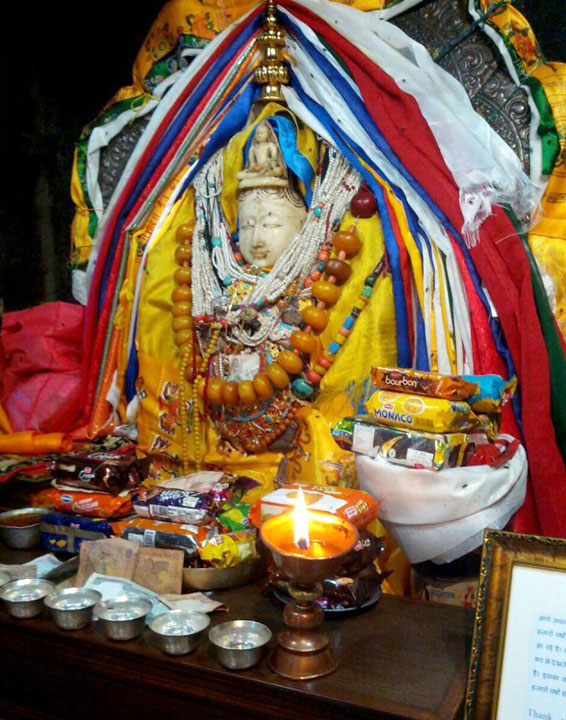
The inner sanctum contains a white marble statue of Avalokiteshvara, bodhisattva of great compassion, believed to be a miraculous self-arisen object found by a shepherd and installed in Triloknath. The statue is revered by Hindus as Shiva.
White marble statue of Avalokiteshvara, Phakpa Temple, Triloknath, Lahaul, revered by Hindus as Lord Shiva. Photo: www.fpmt.org
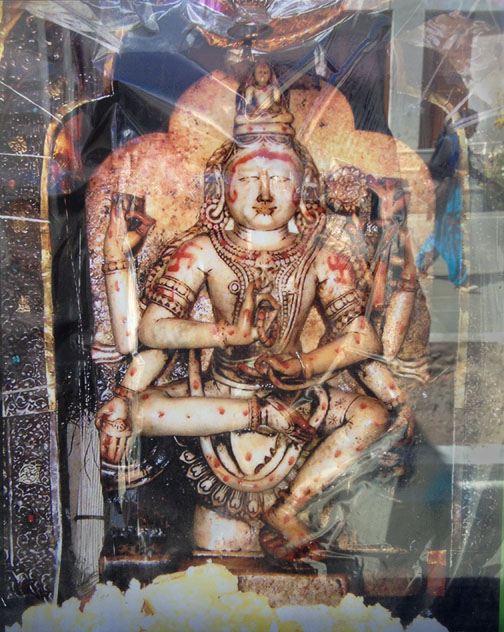
Here is a view of it without ritual embellishments. This is a poster I photographed in the courtyard.
Avalokiteshvara statue at Phakpa Temple, Triloknath, Lahaul
The statue is a six-armed version of Avalokiteshvara. In Tibetan Buddhism, he is also popularly depicted with a thousand arms and eleven heads. This manifestation occurred when Amitabha Buddha, coming to the bodhisattva’s aid, split his head and arms so he could better hear, see, and help the suffering. The Dalai Lama is considered a human incarnation of Avalokiteshvara, or Chenrezig as he is known in Tibetan.
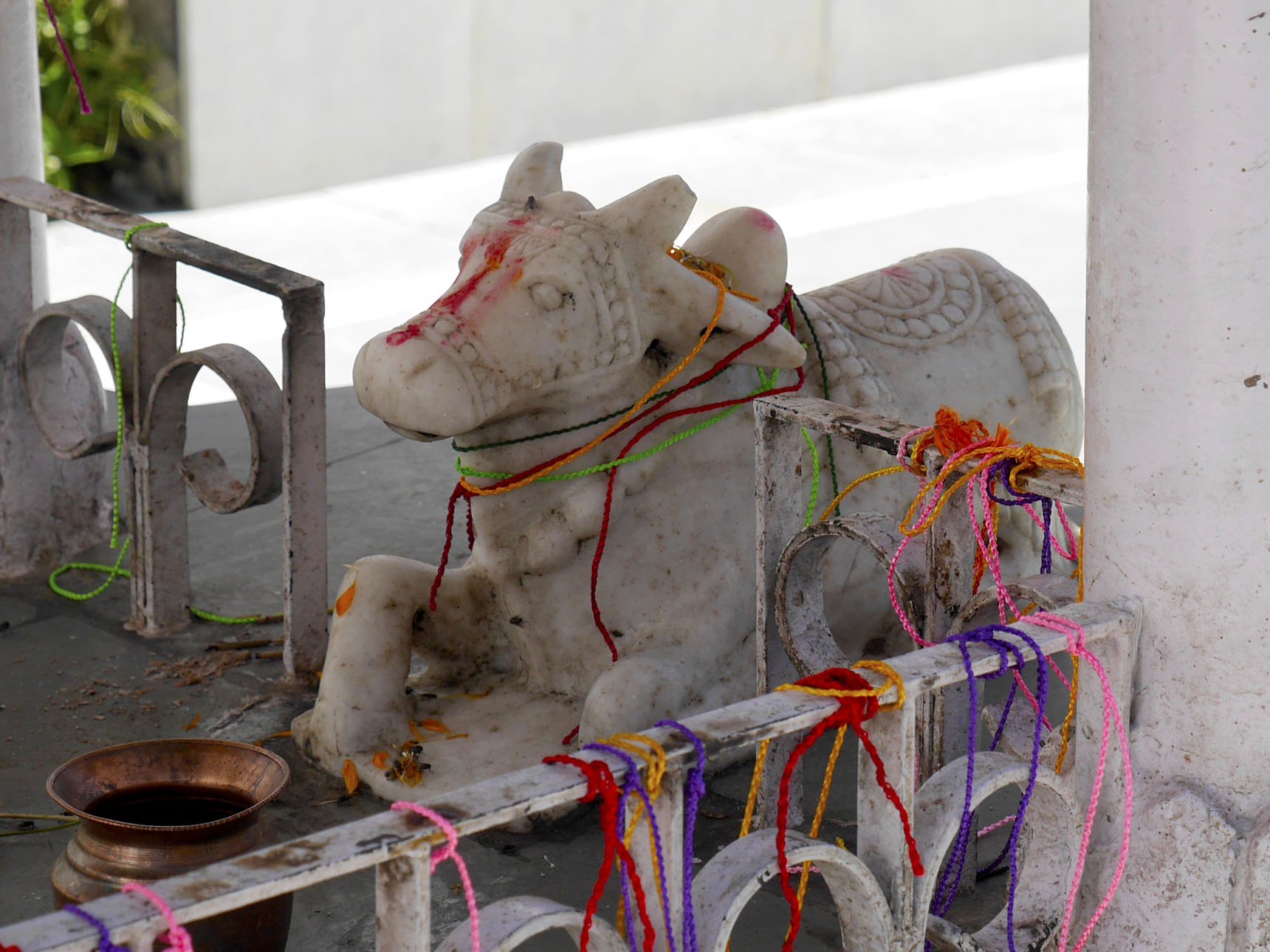
Nandi – the cow is a sacred animal to Hindus, representing life and the sustenance of life. This sculpture is located in the center of exterior courtyard at Phakpa Temple, Triloknath, Lahaul
After Triloknath, I headed to nearby Udaipur to see Markul Devi Temple.
View of Himalayan Mountains on the way from Triloknath to Udaipur, Lahaul
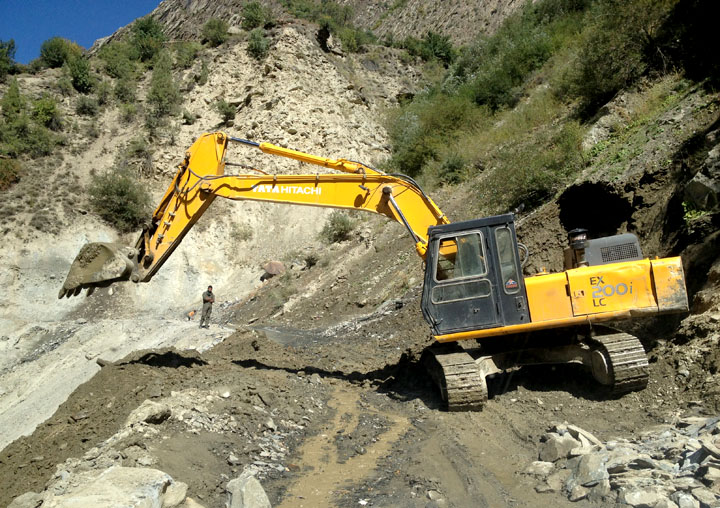
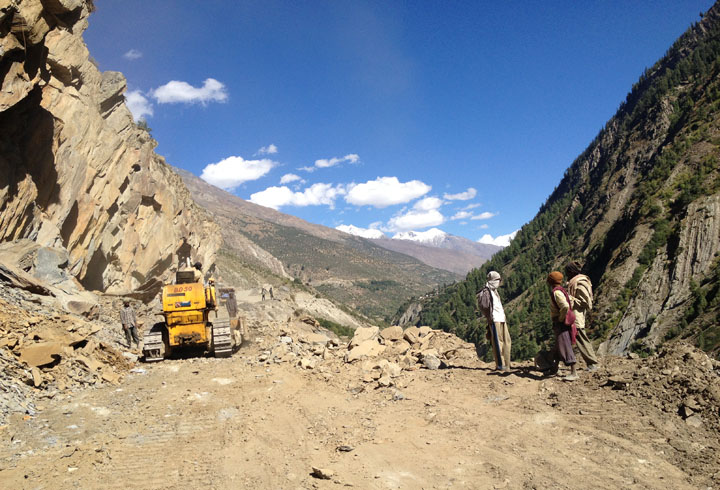
As was the case from Keylong to Triloknath, before long, we hit road construction again and were delayed because all traffic was halted. In this rugged terrain and climate, highways take a beating, and road maintenance and improvement is always happening. This one was a major operation, and not visible in the photo is a large crew of construction workers down the left side of the mountain where the dirt is being deposited.
Road construction en route to Triloknath, LahaulRoad construction en route to Udaipur, Lahaul
Often road workers are women with young children on their backs. Or sometimes the little ones keep themselves busy playing or sleeping on the construction site. I am not kidding! I have seen children sleeping hazardously close to the edge of a cliff, or running among machinery and equipment. So far, on my travels throughout Spiti and Lahaul, this is true everywhere. It is hard labor. Men and women break rocks by hand with hammers, dig mountainsides with pickaxes, haul dirt in baskets on their heads, and so forth. Driver D tells me most laborers are poor and come from Nepal, or are tribals from other states of India. As itinerant workers, they sleep in makeshift tents right there onsite for the season, until the cold weather comes and road work is halted.
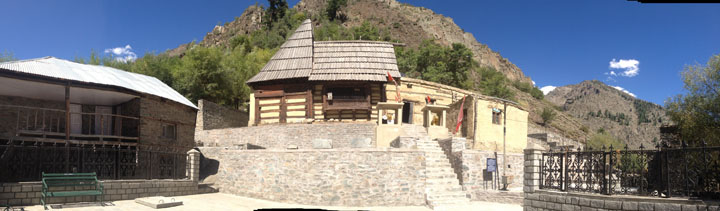
Markula Devi Temple, Udaipur, Lahaul
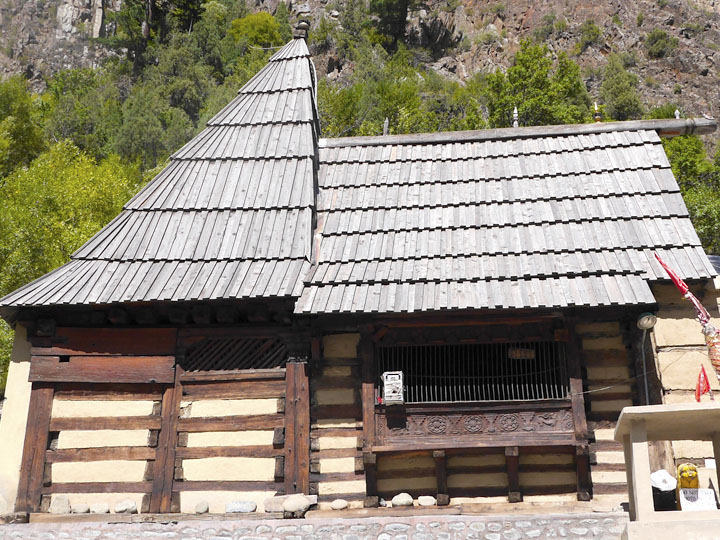
If you have been on an extended trip to see Indo-Tibetan Buddhist sacred sites in Spiti and Lahaul, what is immediately apparent about Markul Devi Temple is that it does not look at all like what you’ve seen elsewhere. Most of the structures I’ve seen from the same period, 11th-12th centuries, have been white-washed or painted mud and stone structures with flat roofs of the same materials, some perhaps thatched. Markul Devi is instead made from wood and stone with a highly pitched wood-shingled gable roof.
Markul Devi Temple exterior is an example of 8th century Kashmiri architecture in Udaipur, Lahaul
The Indian government traces its architectural style back to 8th century Kashmir, though the current structure is a reproduction from 11th century onward. It is protected by Archeological Survey of India, considered the last building of its kind to exist.
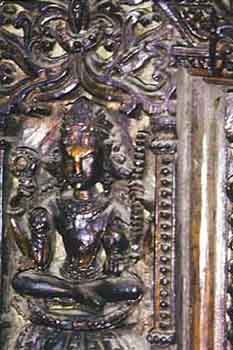
Wood carving from interior of Markul Devi Temple, Udaipur, Lahaul. Photo: http://ignca.nic.in
The interior is also different from other Indo-Tibetan interiors I’ve seen. It is a stunning example of fine Indian woodwork. Massive and deeply carved single pieces of wood form nine elaborate ceiling panels. There are several ornate pillars and architraves, window panels, and the decorated facade of the inner sanctum. The fine carvings depict mainly Hindu subjects and figures, but there are also Buddhist references, such as the panel of Shakyamuni Buddha, and the scene with a three-headed Vishnu. The small shrine holding a silver statue of the Hindu goddess Kali is revered by Tibetans as Vajravarahi.
Shown at right is a detail of the wood carving possibly from the facade of the inner sanctum.
So there you have it…Lahaul’s trinity of Drilbu Ri (body), Phakpa (speech), and Markul Devi (mind)–revered by both Hindus and Buddhists. Implicit in their mutual respect for these places and their associated deities is their acceptance of each other’s pantheon. I admire this. An Indian acquaintance once said to me that he believes, ultimately, all gods are the same.
Lahaul is known by Tibetan meditation practitioners and adepts as Garsha Khandroling, Land of the Dakinis. Dakinis are energetic female spiritual guides often depicted as blissful and fierce dancers.
Lahaul has an illustrious Drukpa Kagyu lineage of highly realized yogis and yoginis who do the Six Yogas of Naropa, esoteric methods bestowed by master to disciple in direct teachings. These are the meditators who go into seclusion in caves or simple dwellings for years or decades in order to realize spiritual liberation–that is to say, Buddha-nature through tantric wisdom and compassion practices.
As I mentioned in my last post, I have heard about some of the mind-over-matter feats that yogis demonstrate which confound conventional explanations, such as levitation, miraculous healing of the sick, making snow fall, taking bad karma upon oneself for the benefit of another. Another perplexing thing, upon death, the bodies of many advanced practitioners do not decay according to the normal time frame of most people. They are believed to be fully aware in the bardo state, the intermediate stage between death and rebirth.
Well, I’ve learned that while it’s difficult to wrap one’s rational mind around such reported phenomena, sitting on the I-don’t-know fence is a flexible and open-minded place to be. After all, outside of spiritual matters we can’t explain, for example, quantum entanglement or what Albert Einstein called “spooky action at a distance,” but it appears to happen!
The great yogi Shakya Shri
Garsha has attracted and hosted countless masters and disciples in pursuit of enlightenment for over 2000 years in unbroken continuity. Inspirations for pilgrims include the sacred abodes of Chakrasamvara at Drilbu Ri Mountain opposite Keylong; Avalokiteshvara at Phakba Temple in Triloknath; and Varjavahari at Markula Devi Temple in Udaipur.
Keylong, Lahaul’s largest village, has several important monasteries only a few kilometers away. These were flourishing Buddhist centers centuries ago, such as Kardang, Shashur and Tayul Monasteries. The oldest one, Gandhola (Guru Ghantal) dates to 1st century C.E. according to archeological evidence. I visited each of these places and to come will be posts featuring them.
View of Gandhola (Guru Ghantal) Monastery, way upper left, with Thupcholing Monastery below on the plateau. Those green-roofed structures are meditation huts for retreatants. Both sites overlook Tandi bridge where the mighty Chandra and Bagha Rivers join in what is considered by Buddhists and Hindus alike as a sacred union.
The delight to be found in Lahaul is that over time, masters have left legends, relics, shrines, stupas, sacred paintings, sculptures, and other spiritual encounters that dot the landscape awaiting discovery by travelers and seekers. The more you look, the more you will see, but it takes some uncovering. For example, what looks unimpressive on the outside may contain a treasure on the inside, such as Jabjes Monastery in Kardang Village. Or one has to do a bit of breathless hiking up a mountain to see some of these old monasteries, hidden meditation caves, and charnel grounds.
Jabjes Monastery located in Kardang Village was built around a legendary rock with the miraculous imprints of yogi Gyalwa Gotsangpa’s knees and genitalia, which formed in the stone as he passionately chased and tried to embrace a dakini who disappeared into it. The rock may be seen today inside the temple, Lahaul, India.
However, I’m told by locals that most visitors just pass through Lahaul, heading to the more tourist traveled and trekked sites in Ladakh or Spiti. What a pity!
More readily noticeable and understood by travelers is that Keylong stretches along the main trade route between the Rohtang and Baralacha passes above the Bhaga River. Besides being a thoroughfare between Ladakh, Kullu and Spiti regions, it is also the district headquarters of Lahaul and Spiti, with strategic military presence. In addition, above and below the village one sees lush farmlands growing barley, peas, potatoes, corn, cabbage, mustard greens, squash, and much more. Apples and other fruit orchards are plentiful. My local driver D told me that agriculture is the economic mainstay of Lahaul, and judging from some of the mansions built by some farming families, the wealth of this abundant agrarian heartland is evident. The food harvested is transported all over India. I would not have guessed that at an altitude of over 10,000 feet there would be such a cornucopia!
View of Keylong on hiking trail from Kardang Monastery to Keylong
D’s ancestral farmland is in the Manali area of Kullu Valley, but he lives and works in Keylong to service the tourist industry as an extension of the family business. Indeed, it’s all in the family. I’ve learned from Lahaulis and Spitians I met that relatives live and work together. This was always the tradition, and it largely continues today.
Another thing I learned was that unlike Tibetans, Lahaulis, Spitians and Ladakhis, while culturally and historically part of Tibet, are indigenous to their regions, and as such are not refugees in India but full citizens. In addition, they have their own language and customs. In fact, the Indian government recognizes them as ethnic “tribals,” who may therefore qualify for certain affirmative action positions or opportunities.
It isn’t only just the passerby tourist who may miss the treasure to be found in Lahaul. I realized that my driver, while he probably identifies himself as a Buddhist, is fairly uninformed about the great legacy of his roots. At one point in our travels, he asked me how much I knew about the Dalai Lama and Buddhism. I thought it was a prompt for me to in turn ask him what he knew and be enlightened by his local knowledge, but it was not a segue way to that at all! He told me he tried to find books on Buddhism in Hindi, but could not. It pained me to hear this–that someone looking for knowledge could not access it.
D said that Lahaulis are educated in Indian schools, are fluent in Hindi but not Tibetan, and frequently not English, either. I noticed this is especially true of the women, who largely live domestic lives caring for family and have little contact with others. English is spoken mainly to communicate with foreigners. Feeling affinity for Indian culture and language, many Lahaulis have assimilated to a large extent in recent generations. Most cannot read the readily available contemporary books in Tibetan on Tibetan Buddhism to fill in on the lack of local education on this topic. Books in English are plenty, but nor can they read these since the written language is “too deep” to understand. It was an exquisite and sad irony that I, a foreigner from the other side of the world, knew more about his spiritual roots than he did. That he, a resident in the incredible Garsha, a descendent of the local culture, could not find one book he could read to study Buddhism deeper!
Farm land and orchards above and below Keylong Village in the fertile valley of Bagha River, Lahaul
It’s a double whammy of cultural distance and spiritual loss. Without being able to study Buddhist philosophy and learn about its unique teachings on dependent origination, one runs the risk of meaningless ritual practice with no or limited realization of freedom from life’s delusions and sufferings.
What’s more, Tibetan Buddhists have a marvelous literary and scholarly tradition, founded on the translation and study of original source materials. Lotsawa Rinchen Zangpo’s translations of Buddhist scriptures from Sanskrit to Tibetan has not only preserved a written heritage now lost in India but produced a renaissance of tantric study and practice. This was during the late 10th to 11th centuries, a flourishing period referred to as the second great propagation of Buddhism. It is the Indo-Tibetan history I’ve been trailing through the sacred art of mandalas, monastery murals, and sculptures.
Garsha: Heartland of the Dakinis
In fact, a (French) Tibetan Buddhist nun, while living in Keylong, discovered the very same thing–that Lahaulis did not know much about the dharma history of their own land. Furthermore, part of why Lahaul’s Buddhist legacy is little known is due to a dearth of literature on it. So she wrote the book Garsha: Heartland of the Dakinis in 2011, published by the Garsha Young Drukpa Association. I have a copy in English, the language it was originally written in. Currently, it needs to be translated into Hindi for local readers.
It is a remarkable small book, jam-packed with a wealth of information about Garsha’s ancient history, the Drukpa lineage masters, dakinis, the founding of monasteries, anecdotes, local legends, descriptions of sacred sites, miracles, reliquaries, carved stones, and much more. It is probably the most, and perhaps only, comprehensive account of Lahaul’s history from the Buddhist perspective. Because it is written by a monastic with open access to living lineage teachers, and unpublished historic materials in Bhoti/Tibetan, the book is a treasure trove of knowledge.
I learned about the book and purchased it from Khandro Thrinlay la when I met her in Manali en route to Spiti (see earlier post here). She is a lama and direct descendent of the Drukpa Kagyu Shakya Shri lineage, with very close spiritual ties to Lahaul. My travel companion J was happy to find it available for sale later in Keylong because she wanted to buy it and donate copies to Tabo Monastery Library in Spiti and The Library of Tibetan Works and Archives in Dharamsala. Funny thing, though, she did not find it in a book store but at a small travel agency/internet cafe establishment run by a lovely Lahauli man keen on the book. You see what I mean? The more you look, the more you will find around here!
Sept 9, 2013 Spiti adventure continues…on to Lahaul, India
After a jaunty jiggly jeep ride of over 10 hours from Kaza back through the magnificent giant boulder rubble of Spiti Valley, Kunzum-la Pass (this time populated by yaks grazing and loafing!) and getting stuck fording a glacial melt waterfall that flooded the rocky road, we arrived in Keylong, Lahaul.
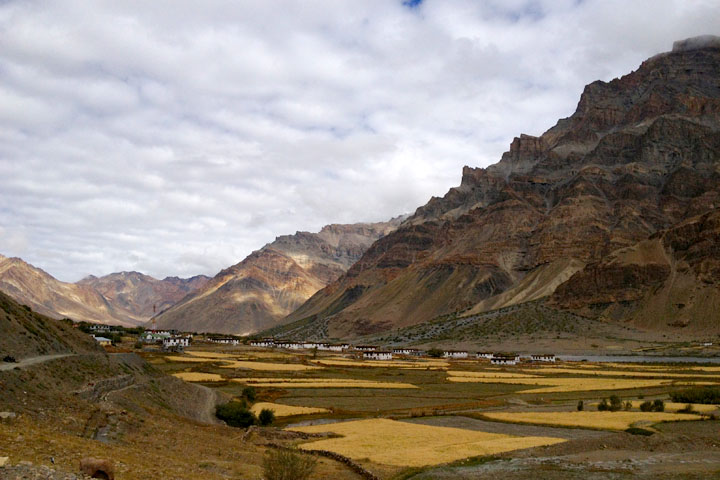
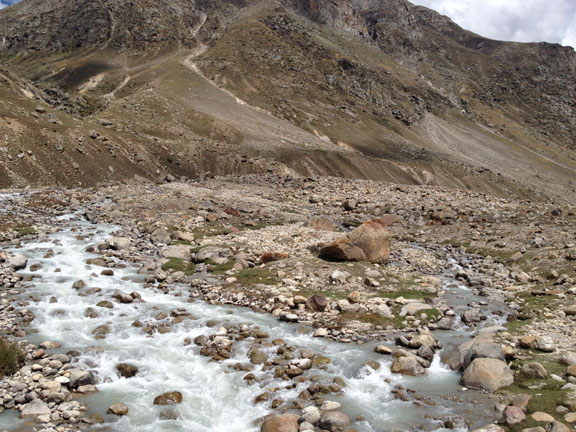
View of farmland in early morning Spiti Valley, en route to Keylong, LahaulSpiti Valley in the marbled early morning sun. As dry and desolate as Spiti may seem, there is always the play of light and colorful vistasApproaching the stupas of Kunzum la pass, the high point of the road at about 15000 ft altitude. This time there was a herd of yak grazing and resting. Glaciers can be seen within relatively close range.Kunzum la pass, where I circumambulated the stupas and got a close look at yaks gathered there. Glaciers can be seen at above left.Herd of yaks dotting Kunzum la pass, at about 15000 feet altitude, the highest point of the road through Spiti ValleyYak grazing, this one looks like he’s molting or has been shavedYaks grazing and resting at Kunzum la pass, seen en route from Spiti to LahaulTibetan Buddhist stupas at Kunzum la pass, monuments in honor of this high point of the road through Spiti ValleyAt this time of year in September, there are streams of glacial melt such as this one which frequently cross the road. They can be as small as trickles or as large as river flows, and it’s wise to travel as much as possible in the morning before the hot afternoon sun increases the flow of these waters that you have to cross with your vehicle.Huge boulder piles along the road from Kaza, Spiti, to Keylong, Lahaul. It’s difficult to judge the monumental scale from just a photo, but to give you an idea, this foreground rock is as tall as a person.Huge boulder piles along the road from Kaza, Spiti, to Keylong, Lahaul
Magnificent and desolate…
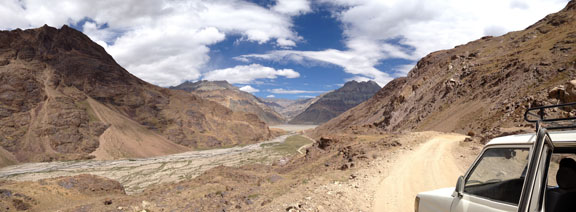
Our jeep on the road through the dry desert terrain of Spiti Valley, India
Once you experience the vast scale of the Himalayas, you can readily understand why the environment induces existential concerns and spiritual development. There’s nothing like realizing our small duration as human beings in the context of gigantic geological time and space, and beyond this, the grand cosmos to put human desires and expectations into a completely different focus.
A large Tibetan Buddhist stupa is dwarfed by the magnificent scale of the Himalayan mountains
Here is our jeep stuck on rocks while attempting to ford the rapidly flowing waterfall that flooded the road in the afternoon. We had patiently waited while the vehicle before us was stuck and finally managed to get out. In that 45 minutes or so, unfortunately, the water flow started increasing as the hot afternoon sun melted more glaciers! We got out eventually though with the help of others waiting to pass, including military men and a monk who moved earth and rubble, pushed and rocked the car, as our driver revved forward.
Our jeep stuck on rocks while attempting to ford the rapidly flowing waterfall that floods the road in the afternoon in Spiti Valley.The said rapidly flowing waterfall which created a river across the road, Spiti Valley, India
In contrast, as you approach and enter Lahaul Valley, high waterfalls are plenty but do not flood the roads. Lahaul is also a welcoming green landscape with grass, shrubbery, trees, and evergreens. The region is also well known for its delicious potatoes, as well as crops of barley, peas, cabbage, apple and other fruit orchards. Even here in high altitude, it is a heartland for growing food to be transported throughout India.
One sees many high waterfalls throughout the more verdant Lahaul Valley
With arrival in Keylong, Lahaul, in late afternoon we spent the rest of the day trying to get some logistics done. For my part, it was to get (yet another) SIM card that will get a cell signal here in the high Himalayas, and hopefully maintain a signal when I later travel to Ladakh further north. After the last week in Kaza, Spiti, without any cell phone coverage by my existing SIM card to communicate with family or arrange meetings or call for travel, etc., I decided to get another with a different carrier. Here in India, there is no single carrier that can provide national coverage, so one gets used to swapping out SIM cards and switching providers as the need arises when you travel from area to area. I have three SIMs now. The last one took so long to do—don’t ask the maddening details about how it took well over two hours to buy the SIM in one place and take it to another place to cut down. Around here you get used to relatively simple things taking an inordinate amount of time to accomplish, in this case, out of lack of coordination and know-how on merchants’ part. I’ve learned to smile a lot, shake my head, and say to myself, “It’s India…” Trust me, even Indians say this!
I never got to treat my very dry leather shoes as I had promised myself. They look like they’re going to crack from the dust-pounding they get in this high desert climate and unpaved roads. Nor did I get to download from the internet café the software plug-in I desperately need to manage my photographs. I couldn’t do it in Spiti because my download was too big for the internet café’s monthly ration of data permitted. Who knew an internet cafe would be rationed for data?! But, ok, lack of resources…I shook my head and smiled, it’s India.
But what India lacks, it definitely makes up for in its sublime experiences!
View of Keylong nestled in the Bhagha River Valley, Lahaul
Which brings me to Lahaul, also known by Buddhists as Garsha Khandroling, a region with a deep history of highly realized yogis. These are the practitioners who spend many years or decades in seclusion meditating in caves. You may have heard about adepts who can demonstrate astounding practices of mind over matter, such as levitate or dry wet sheets in the snow with heat generated from their bodies, confounding the scientists who studied this phenomena. Or you may have heard of Jetsunma Tenzin Palmo, the American Tibetan Buddhist nun and her Cave in the Snow. In any case, more on Garsha in the next post…
It will be a bit out of order, but what the heck….Of course, I mean out of sequence, not broken!
I’m working on retroactive blog posts of basically all my experiences from last month’s travels through Spiti, Lahaul, and Ladakh to research and document Indo-Tibetan murals. Why didn’t I just post along the way? Because, internet stick and four SIM cards later, I was not able to access the internet while on the road. Especially in electricity-challenged Spiti, where kerosene for generators is even rationed, and Ladakh, border security area where cellular and other signals are highly controlled. I gave up trying and decided I would post when I got back to Dharamsala.
And here I am back in Dharamsala…but I did not think it would take long to back-post since I’ve already written a lot of material while still traveling. However, with image management and identification of thousands of photos shot in monasteries, it’s proving to be more time-consuming to present with accompanying photos. And who wants to read text here without the images? Not me!
So here’s what I’m going to do. I’m going to toggle back and forth between posting about the present, and posting about last month, as I continue researching here in the lower Himalayas. In addition to Dhangkar and Lhalung Monasteries which are already here on this blog, stay tuned for accounts of what I saw and did at Key Monastery, Tabo Monastery, Kardang, Guru Ghantal, Shashur, Tayul, and Poekar Monasteries, including Phakpa in Triloknath and Markul Devi Temple in Udaipur sojourns. Then Alchi, Mangyu, Lamayuru, Likir, Shey, Thiksey, Hemis, and Mulbek Chamba Monasteries. Yes, jam-packed with history, anecdotes, incredible landscapes, and ponderings!
Spiti Adventure Begins
Posted
My home corner in Dharamsala, with Namgyal Monastery entrance at right.
September 1st
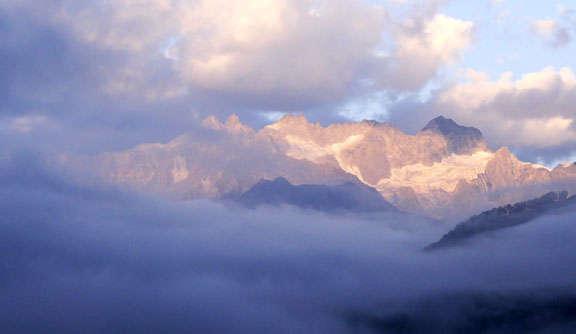
J and I started off for Manali 6am from Dharamsala, watching the sun rise along the way. At a certain altitude, the sun in full array, we saw a veritable Roerich painting before our eyes. It was snow-peaked mountains appearing to float above a thick, solid, fluffy white cloud bank. I always thought the man took artistic license with his imagery, but sure enough, the chiseled facets cast by morning light on the Himalayas were in orange and purple-gray displays, the base of the mountains nestled in airy clouds. The scene looked like a fairytale setting.
My first encounter with Nicholas Roerich-like scenery. I always thought the painter used artistic license to enhance colors and compositions of his Himalayan scenes, but they in fact look this dreamy and stunning
The main road where Rohtang pass is looks by our standards like a single lane dirt road. There is no railing at the irregular precipitous edge, and passing the slow trucks that ply the road means a lot of honking on the driver’s part and then a wing and a prayer to get back in lane without encountering oncoming traffic. Might makes right on Indian roads so trucks have the de facto right of way. Somehow it all works out, amazing.
I got a bit carsick from the descent, switchbacks all the way, the driver taking them maybe a bit faster, with blind passing, than my stomach could take. The diesel fumes and road dust was killing me. The smell of diesel alone is enough to nauseate me. Fortunately, there was AC which I asked for halfway through. We arrived around 1pm, with pitstop for breakfast at cheesy hotel bar/dining hall (J said she’d have to work on the driver to get him to choose better stops). Well, anyway, the aloo parathas (potato-filled flatbreads) were tasty and it was good to use the bathroom. Otherwise, it’s a roadside affair of finding a large rock or bush to go behind when nature calls!
We stayed at a place called Leela Huts after finding that J’s fave old Johnson’s Lodge, with English-styled cottage accommodations, was under renovation and closed. Leela Huts has a hilarious website: www.leelahuts.com. The sentence that had us in tears with laughter was, “Leela Huts swear sheer solitude to that tired man who has retired to the valley for a bracing vacation, away from the irksome crowd.” Now there’s some florid Indian English for you! But anyway, it was a well-kept, walled off little oasis with two and three-bedroom houses with full kitchen and baths. We opted for just the hut with single large room.
We hightailed it to Manali because Khandro Thrinlay-la was in town for the afternoon before needing to leave for her next teaching engagement, and she invited J and I to come for a visit. OK, so here is one bit of convoluted family history. Her older brother is Sey Rinpoche, their father a great Drukpa Kagyu practitioner named Apho Rinpoche, who descended from the great grandfather Shakya Shri, who began this special lineage of masters in the Six Yogas of Naropa, a Milarepa tradition. These are the accomplished meditators who retreat for three years, three months, and three days to practice the secret tummo and other methods which develop, I am told, levitation skills and various abilities that defy convention. You would never know who was a great practitioner usually because they can look like any humble villager, and they never reveal their abilities normally.
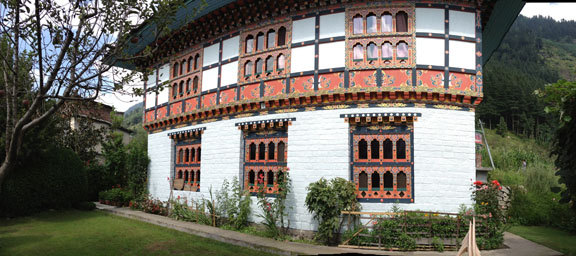
Khandro-la’s Bhutanese-style temple, Manali
Sey Rinpoche was supposed to be in Manali upon our arrival to meet with us, and make arrangements for access to monasteries in Lahoul where the family hails from, but we found he had left for Pangi where he is building a new retreat center. Instead, his sister Khandro-la (www.khachodling.org) was at home briefly, a lovely Bhutanese-styled house with colorful painted motifs on the crown and windows. She received us in her prayer room where she was doing prayers for safe travels, since it is the astrological snake year, and by Tibetan beliefs an obstacle year for those born in snake years. I thought snake year was auspicious for snakes, but this must be the Chinese thinking. We discovered we all three are snakes.
Khandro-la has an international following which includes a lot of Australians, and women. She has a feminist approach, and is educated in the U.S., with MA in psychology, completed by the advice of none other than His Holiness the Dalai Lama. I find her interesting and contemporary. After learning about my Fulbright project, she asked me to photograph the murals at Gandhola, which turns out to be Guru Ghantal where I had planned to visit and document. She said it’s the oldest temple in Lahaul and she is interested in preserving its heritage properly.
We went back late in the afternoon to see Khandro-la’s assistant, and her younger brother who runs Druk Expeditions. He gave suggestions on places to visit in Lahaul, and so did Khandro-la’s assistant. It turns out that there is not so much to see in the way of murals of mandalas in Lahaul, but rather, Lahauli temples and area are structured spatially like a mandala. The suggestion was to go for a kora (a clockwise circumambulation around a sacred location) of Drilbu Ri Mountain, a holy site of the tantric deity Chakrasambhava, near where Guru Ghantal is, and experience the mandala physically, but to hire a guide so as not to get lost, and also to help carry things. Sounds like a nice idea, but we’ll see how I adjust to high altitude by then! I have so far been suffering from night headaches (like having a vice grip around my head!) and shortness of breath, bit of loss of appetite.
Often the road in Spiti is nothing more than rocky terrain in which one must ford a glacial stream.
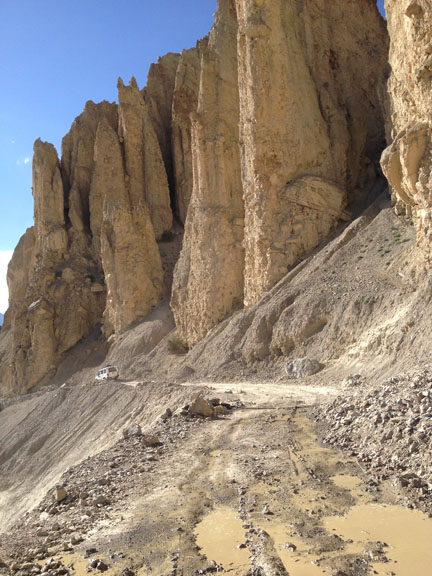
Next morning 5am we were off to Spiti. Aaah, at last the journey to high Himalayas truly begins! Our driver was a nice man, very good careful driver, and not as aggressive as some others. He drove a Toyota Qualis which J remarked didn’t look like the most comfortable car, but it was a tanker, and boy, I was happy about that. You wouldn’t believe how parts of the road were like fording small rivers and waterfalls, with large rocks and vertiginous drops! These are areas where glacial melts can wash out the road by afternoon. After a couple of particularly nerve-wracking spots, we cheered our driver for his skillful driving! J said many a car or truck has been caught stuck in these. One has to be on the road early enough to pass these before the water starts rushing down in the warmest part of day.
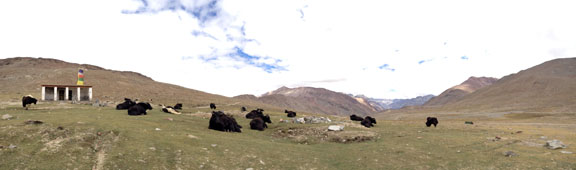
Kunzum la with herd of yaks, altitude of about 15,000 feet
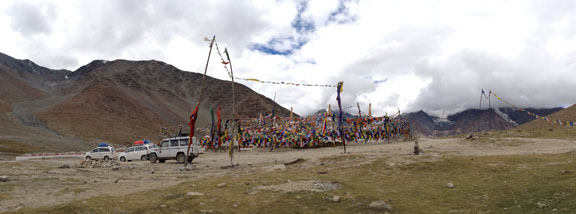
I took a lot of photos en route, what spectacular vistas! We had also many pit stops at big rocks where we could hide and relieve ourselves by the side of the road. Kunzum-la was quite windy. It’s a high point at about 15,000 ft altitude, and marked by three stupas and small shrines to the Dalai Lama and Karmapa and other lamas. J and I made incense offering here as a Geshe-la (title of a learned Tibetan Buddhist scholar akin to a PhD) suggested was an auspicious thing to do en route. I was feeling the shortness of breath by now, and when the wind blew the incense into my face, the odor caused me to feel nauseous. However, I totally loved seeing the wildly billowing and plentiful, layered, colored prayer flags blowing in the wind. We ended up not picnicking at the Nechung stupa as originally planned because J thought it was too windy and cold. She was mindful not to be exposed too much in case of causing illness. We instead ate in a large, flat valley, which was also windy, but at least less so.
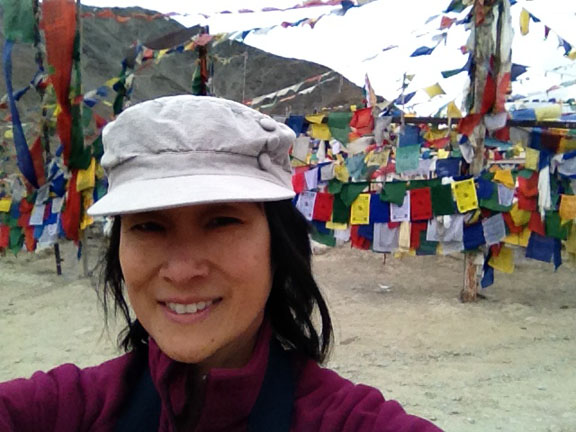
Tibetan prayer flags and stupas mark Kunzum la pass
Exhilarated and a bit short of breath at Kunzum la pass, altitude approximately 15,000 feet
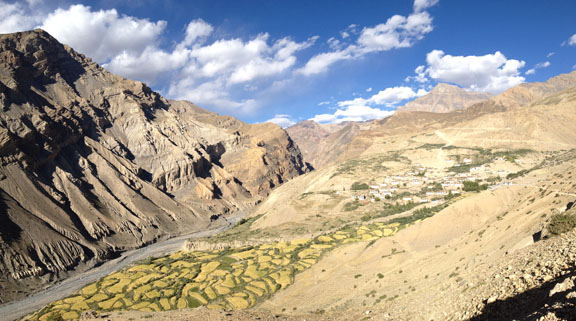
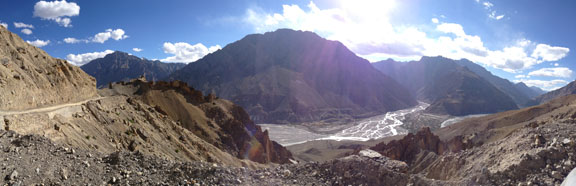
The Spiti Valley is grand beyond belief! While passing Kullu Valley earlier was stunning, too, for its lush steep landscape, cascading, tall waterfalls that put Yosemite National Park ones in the kids’ playground, grazing sheep and goats, impossibly tall and regal pine trees, Spiti land looks like gigantic rock and sand slides of barren beauty, with a wide river valley that equally shocks one with its scale. The river rushes in what looks like silver rivulets wending its way within the valley from the road high above, but any of its strands would dwarf a normal inland river. J said this is what is characteristic about Spiti, and at every switchback turn on the road, another great Roerich-like view is to be had. If I had stopped the car every time I wanted to take a photograph, we never would have arrived in time. Manali to Kaza was about a 10-12 hour jaunty, bumpy car ride.
En route to Kaza, Spiti, a high altitude desert landscape
Magnificent rock structures, nature’s sculptures, en route to Dhangkar Monastery, Spiti
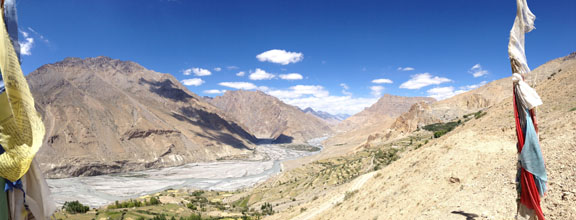
Spiti Valley heading towards Dhangkar Monastery. The grandeur of scale is stunning!
Himalayan scale is overwhelming. What looks here like squiggly bits of green is actually massive farmland. En route to Dhangkar Monastery
En route to Dhangkar Monastery. Spiti Valley in any lighting is stunning.
This is not an official U.S. Department of State website. The views and information presented here are solely those of the artist, and do not represent the Fulbright Program, the Department of State, or any other entity.