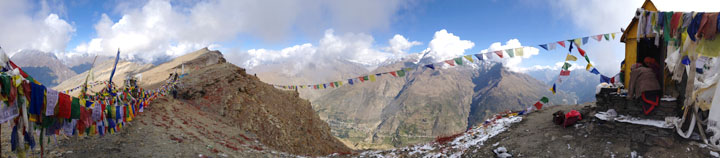
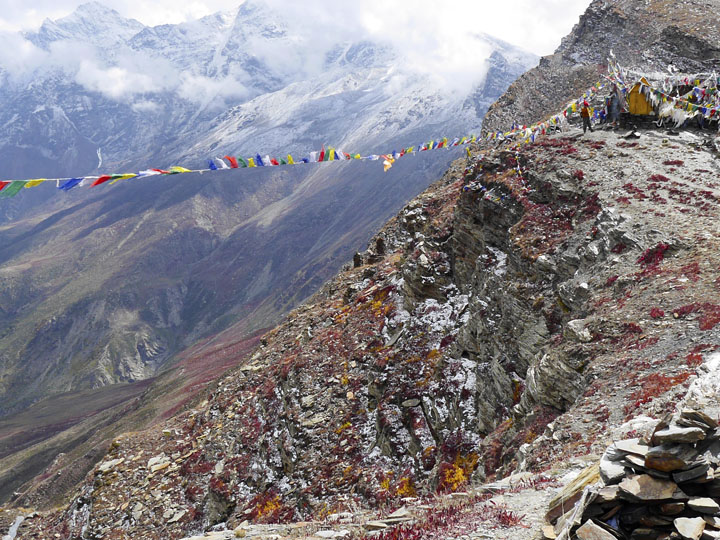
Mount Kailash

Wow! The Kailash Temple of Ellora Caves, Plus Indra Sabha, Nudity, and the Dalai Lama

December 12-13, 2013

The Kailash Temple (Cave 16) is arguably the most famous one of all 34 caves at Ellora Caves. My previous post was about the marvelous Buddhist ones, but wow, this Hindu site is remarkable!

Base of the main temple, Ellora Cave 16

Built in the 8th century by the Rashtrakuta king Krishna I, 756-783 C.E., it is the most advanced excavation. An enormous Brahmanical complex, its most unrivaled feature is the free standing main temple in the center.

Did you read that right? Yes, you did! This “cave” has an open courtyard with a free-standing centerpiece, which entailed an ambitious, massive vertical excavation of incalculable tons of rock by approximately, I read, 17,000 laborers over the course of about 100 years. Vertical means that the structure was created by carving from top to bottom to realize this multi-level Dravidian-styled temple. What a feat! This magnificent cave is probably the largest excavation in the world measuring 276 feet  long x 154 feet wide x 107 feet high.

What’s more, the complex is surrounded on three sides by colonnaded walkways three stories high with extensive overhang. There are huge carved panels there and alcoves with enormous sculptures of Brahman deities.

Panoramic view of Kailash Temple from the colonnaded walkway, Ellora Cave 16
Panoramic view of Kailash Temple from the colonnaded walkway, Ellora Cave 16, Hindu
View of colonnade walkway near back of main temple., Ellora Cave 16
View of colonnade walkway near back of Kailash Temple. Visible at right is the extended overhang.
View down the length of colonnaded walkway, Ellora Cave 16
View down the length of colonnaded walkway, Ellora Cave 16, Hindu

Kailash Temple, as its name suggests, is intended to recall the sacred Mount Kailash. This Himalayan mountain is an abode of Lord Shiva, and Ellora Cave 16 is dedicated to him.

Kailash is incidentally located in Tibet, and is one of holiest of the holy mountains for both Hindus and Buddhists alike. A pilgrimage there and circumambulating its base earns one great spiritual merit.

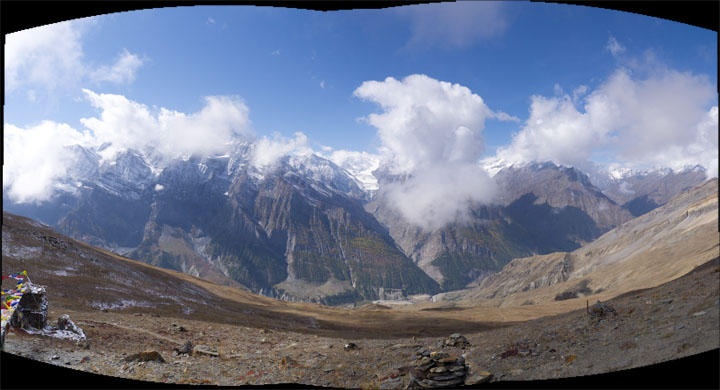
Mount Kailash, Tibet
Left: Mount Kailash north face. Right: Mount Kailash south face, Tibet. Kailash Temple, as its name suggests, is intended to recall the sacred Mount Kailash. This Himalayan mountain is an abode of Lord Shiva, and Ellora Cave 16 is dedicated to him.

In my earlier Fulbright travels, I went to three other places in the Lahaul region of the Indian Himalayas that were also revered by both Hindus and Buddhists–Drilbu Ri Mountain, which I climbed to reach its 15,000 foot summit, Phakba, and Markul Devi Temple. I really admire that there has been a long history of mutual respect and shared reverence between these two indigenous major religions in India.

In addition to the expansive colonnaded walkways, within the courtyard of Ellora Cave 16 there are two other main structures. As is traditional in Shiva temples, the first is the Nandi Temple at the entrance. I actually missed seeing the sacred bull within in because I was mesmerized by the rest of the “cave” and just kept walking on!

The entrance and Nandi pavilion, Ellora Cave 16
The entrance and two-storied Nandi Mantapa or pavilion, Ellora Cave 16, Hindu
Ellora Cave 16, India
Side santuary within the courtyard near entrance of Ellora Cave 16. To its right is the beginning of the arcade that surrounds three sides of the complex
Upon entering through the Nandi gate, you are greet by Gajalakshmi, the goddess Lakshmi surrounded by elephants on a lotus pond, Ellora Cave 16
Upon entering through the Nandi paviion, you are greeted by Gajalakshmi, the goddess Lakshmi surrounded by elephants on a lotus pond, Ellora Cave 16

The second structure is the main Kailash temple. Its base is carved with graceful life-sized elephants, lions, and mythological figures.

Base of the main temple, Ellora Cave 16
Graceful elephants standing at attention appear to uphold the base of Kailash Temple, Ellora Cave 16, Hindu
Base of the main temple, Ellora Cave 16
Visitors circumambulate the main temple, Ellora Cave 16, Hindu
Walking up to main temple, Ellora Cave 16
Walking up to main temple, Ellora Cave 16. Traces of a formerly painted ceiling are visible.
Entrance to main temple, Ellora Cave 16
Entrance to main temple, Ellora Cave 16. Traces of painted facade can be seen on pilaster and elsewhere.

Upon entering, I feasted my eyes on the impressive intricacy of its interior. The central hall was richly carved. Everything, from its niches, pilasters, deities, figures, columns, etc., are ornamented. Most of the deities at the left of the entrance are Shaivaite (followers of Shiva) while on the right hand side the deities are Vaishnavaites (followers of Vishnu).

Interior of main temple, Ellora Cave 16
Interior of main temple looking towards the inner sanctum, Ellora Cave 16, Hindu
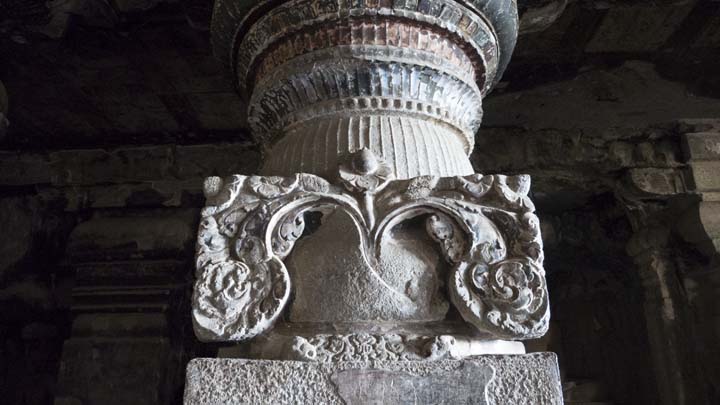
Detail of carved column, main temple, Ellora Cave 16
Detail of carved column, main temple, Ellora Cave 16, Hindu

The inner sanctum contains a large lingam, representative of Lord Shiva. Devotees leave offerings of flowers, money, candles and other objects.

See image of lingam here.

Lastly, there is a significant sculpture at Ellora Cave 16 of Ravana, principle antagonist in the Hindu epic Ramayana, attempting to lift the abode of Lord Shiva, Mount Kailash, with all his might. It’s an unusual and expressive composition.

The Jain group of caves number 30-34, and they were the last to be excavated, circa 800-100 C.E. I was struck by Cave 32, also known as Indra Sabha, because it’s similar to Cave 16. It also features a central free-standing temple inside a courtyard, as well as Dravidian gate, and monolithic elephant sculpture by the entrance . Though smaller in scale, there are details of this cave that surpass its predecessor.

Ellora Cave 32, India
Ellora Cave 32, Jain temple, India

For example, the carved details and the unique designs of the columns on the second floor of the main temple truly outdo even the ornately decorated columns of Kailash Temple. They are massive in size and are carved in high relief. Some look like urns with draped garlands.

Ellora Cave 32, second floor, India
Ellora Cave 32, Jain temple, second floor, looking towards inner sanctum
Detail of column, Ellora Cave 32, second floor, India
Detail of column, Ellora Cave 32, Jain temple, second floor
Detail of column, Ellora Cave 32, second floor, India
Detail of column, Ellora Cave 32, Jain temple, second floor, India

Indra Sabha is actually a collection of shrines dedicated to the revered Mahavira, the 23rd tirthankara .
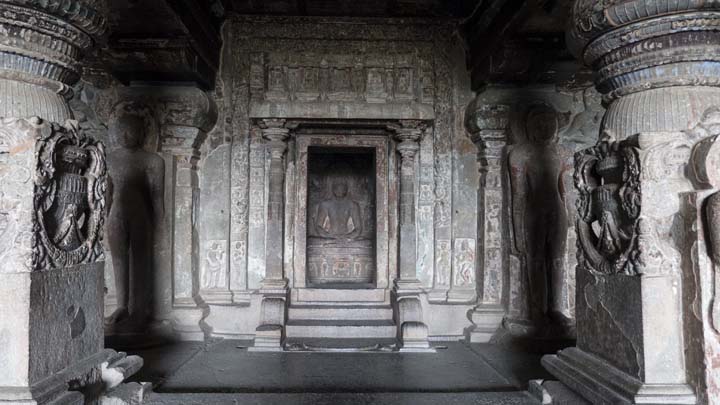
Ellora Cave 32, second floor, India
Inner sanctum with Mahavira statue, Ellora Cave 32, second floor, India

Mahavira (ca. 540-468 B.C.E.) was a contemporary of Buddha. The two had remarkably similar experiences and teachings. Like Buddha, Mahavira was born into a royal family. At the age of 30, he left his home in pursuit of spiritual awakening. Through ascetic practices for over twelve years, he achieved enlightenment. He traveled all over India for another 30 years to teach his philosophy, based on ahimsa (causing no injury through one’s deeds, words, or thoughts–which corresponds to Buddhist notions of body, speech, and mind); satya (absolute truth, like Buddhist right view); asteya (not stealing, or as Buddhists phrase it, not taking what is not freely given); brahmacharya (spiritual study, practice, and abstinence, similar to Buddhist monastic vows); and aparigraha (non-grasping or non-possessiveness, which forms part of the Buddhist idea of non-attachment and egolessness.) Mahavira attained nirvana after his physical death at the age of 72.

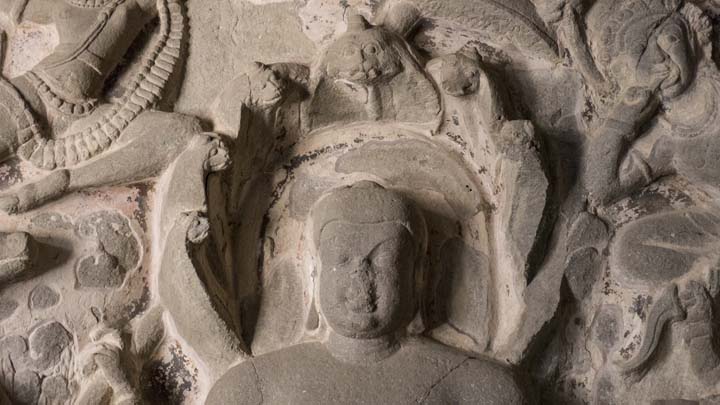
Mahavira, Ellora Cave 32, India
Mahavira, Ellora Cave 32

Jain depictions of Mahavira are also remarkably similar in appearance to Buddhist images of Buddha. With one key difference: Jain deities of the Digambara sect are nude.

When I saw Mahavira in an inner sanctum, I must admit that I was a bit surprised by the anatomical accuracy of his nudity. (The sacred art tells it like it is!)

But it’s not only Jain deities. The yogis, too. It reminded me of an anecdote the Dalai Lama told, and it goes something like this:

Once, at a ceremony in India, he found himself seated next to a Jain yogi who was stark naked. The Dalai Lama, shocked, had looked him up and down. “He just showed—everything! All of his things were right there!” He couldn’t help but keep looking at the yogi, but not because of his “thing.” Because he was so impressed with the intensity and forthrightness of this man’s practice! And so, the Dalai Lama got down on his knees and touched his forehead to the yogi’s knee as a sign of respect for him and his dedication to contemplative practice.

Gomateshwara, Ellora Cave 32

Pictured above is the revered Gomateshwara, also known as Bahubali.

Detail of Gomateshwara, Ellora Cave 32

Below is the 23rd tirthankara, Parsvanatha, with his characteristic snake hood.
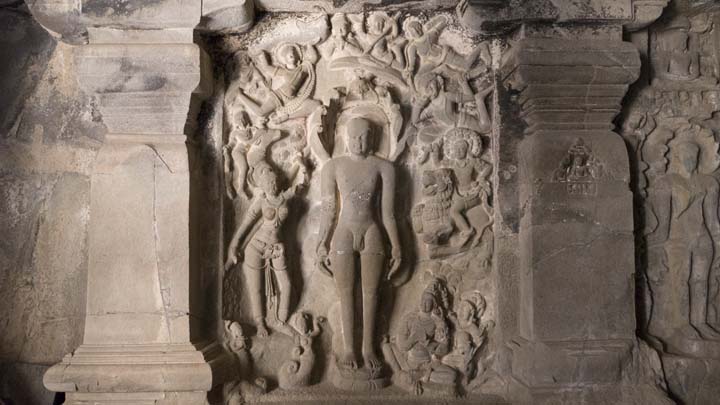
Parsva, the 23rd tirthankara of Jainism, side wall, Ellora Cave 32, India
Parsvanatha, the 23rd tirthankara of Jainism, side wall, Ellora Cave 32
Parsvanatha, Ellora Cave 32, India
Parsvanatha, the 23rd tirthankara of Jainism, with his characteristic snake hood, side wall, Ellora Cave 32, Jain temple

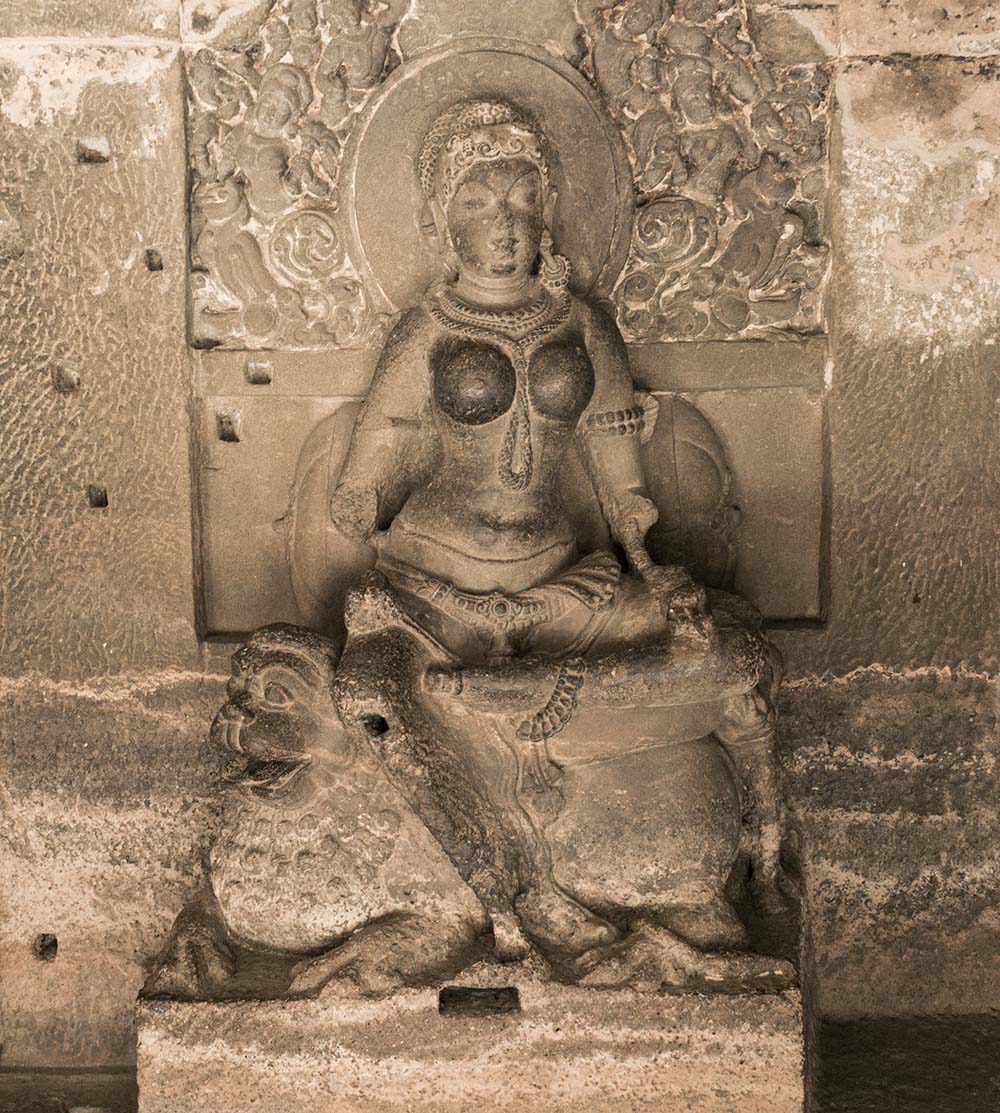
Mahavira is usually flanked by his attendant deities, Indra on an elephant and Ambika on a lion. I found these two carvings especially well done.

Indra, Ellora Cave 32, India
Indra riding on an elephant, Ellora Cave 32, Jain temple, India
Ambika, Ellora Cave 32, India
Ambika riding on a lion, Ellora Cave 32, Jain temple, India

So there you have it…Ellora Caves–what a revelation in artistic and architectural excavation!

Panorama of Ellora Caves, near Aurangabad, India.

All photos © 2013, Eva Lee.

Drilbu Ri Mountain Mandala

Sept 16th Drilbu Ri Mountain kora (circumambulation)

5 a.m. with flashlight in hand and some provisions in a backpack, I started out in the dark to meet my guide S at a spot on the Drilbu Ri trail marked by a large barren tree.

Beginning of trekking trail of Drilbu Ri kora (circumambulation) from Kardang Monastery, Lahaul
Beginning of trekking trail for Drilbu Ri kora (circumambulation) from Kardang Monastery, Lahaul. The destination is the top of the mountain near where those seven peaks appear at upper left.

I had spent the night at Kardang Monastery, and once again had the pleasure of the company of nuns. It’s remarkable how details of one’s life narrative can be dispensed with when there is just mutual warmth felt between people. We chatted with whatever English they had (and for my part, zero Tibetan) and with mutual hand gestures. They cooked thukpa noodles in a delicious vegetable soup. I hadn’t eaten much that day having worked through lunch shooting photos at Guru Ghantal, so I was happy to carb-up for the next day’s trek.

Lovely Kardang Monastery nuns making thukpa noodles for dinner
Drilbu Ri mountain as seen from across the Bhaga River, Lahaul

Drilbu Ri kora—my gosh, what can I say? Getting to the summit whooped me! At almost 15,000 feet (4400 meters) altitude, I was short of breath at the start, and then later gasping for breath every 10 to 15 paces of steep uphill climbing. We reached the top shortly before 10 a.m. My guide, bless him, was so patient, calm, and encouraging with the words, “Slowly, slowly…” which he repeated like a mantra, each time with a gentle head tilt, the infamous Indian bobble.

Drilbu Ri trek, Lahaul
About two hours into trekking with guide S, Keylong is seen below (looks like thin line) on the opposite mountain across the valley.
Drilbu Ri Mountain, Lahaul
Ascent further up takes you into an area filled with a kind of red grassy plant that colors the mountain side
Drilbu Ri Mountain, Lahaul
As we climbed higher the mountain curved more and changed to rocky terrain
Drilbu Ri Mountain, Lahaul
Further up, the mountain is steeper, more angled, and here is where we hit the snow line, snow visible on right

The last part was the steepest and most difficult. I marveled that I was still going on only half a Nutella sandwich, some pieces of chocolate, and two mango juices. Hardly nutritious, but then again, hunger becomes more of a concept, given the altitude and level of exertion.

Looking up towards the summit, Drilbu Ri Mountain kora, Lahaul
Looking up towards the summit of Drilbu Ri Mountain, the top being where those prayer flags look like a dotted line. At this point more snow on the ground. Yes, it looks steep and then got even steeper!
Drlbu Ri Mountain, Lahaul
Still looking up at the summit, the ascent gets more vertical and narrower!
Finally at the top, you arrive through this narrow notch in Drilbu Ri Mountain
Finally arrival at the summit of Drilbu Ri by scrambing through this narrow and angled pass

Well, it was worth being reduced to crying “uncle.” When we got to Drilbu Ri’s summit, it was indeed a living mandala as the locals promised. 360-degree panorama of magnificent glacial mountains that take your breath away–literally and figuratively! No wonder the Himalayas is called “the roof of the world.” As you stand stuck in awe, the amazing height and expanse somehow melds with your inner sense of worldy, or maybe otherwordly, home. Yes, you, small and insignificant in this vast geological time and space, still get to be part of it all.

View of Keylong down in Bhaga River Valley from the summit for Dribu Ri Mountain
Dribu Ri Mountain on other side, Lahaul
Unbelievable immensity, view of the other side of the Drilbu Ri Mountain looking down towards Gondhala Village. This is where you begin the descent down, a lot less steep but looks deceptively smooth and “easy.”
View of Keylong down in Bhaga River Valley from the summit for Dribu Ri Mountain, Lahaul
View of Keylong down in Bhaga River Valley from the summit of Dribu Ri Mountain, Lahaul. On right is a Buddhist shrine housed in a small yellow structure in which Lahauli pilgrims are lighting butter lamps and incense as offerings. Hidden under many kata offering scarves further to the right is also a small Hindu shrine dedicated to the sacred union of Shiva and Parvati.
Butter lamps and other offerings in Buddhist shrine on top of Drilbu Ri Mountain, Lahaul. Hindus also consider this a sacred site and there is a shrine, too, dedicated to the sacred union of Shiva and Parvati
Butter lamps and other offerings in Buddhist shrine on top of Drilbu Ri Mountain, Lahaul. Hindus also consider this a sacred site and there is a separate shrine dedicated to the sacred union of Shiva and Parvati.

In fact, Drilbu Ri is sacred to Tibetan Buddhists as Chakrasamvara’s abode. It is important to understand here that none of the Buddhist tantric deities are believed to exist externally. Rather, they represent the ultimate and profound state of mind which sees that self and phenomena are empty of inherent existence. If this is an intriguing idea for you, then you may want to learn more about the distinctive Buddhist philosophy of dependent origination.

Chakrasamvara, wall painting, Gandhola Monastery, Lahaul, India
Chakrasamvara, wall painting, Gandhola Monastery, Lahaul

Chakrasambava is understood as a wrathful manifestation of Buddha for combating the compelling mental condition of perceiving things as concretely existing. Tantric yoga practices are essentially visualizations of the deity that enact illusion and dissolution of self through identifying with the deity’s Buddha-nature. With the initiation and guidance of a qualified teacher, the practitioner gains the benefit of seeing things as they really are—that is, illusory and empty of inherent existence. This is what’s called wisdom. Cultivating wisdom together with compassion form the complementary two wings for full flight to enlightenment.

Tibetan Buddhists believe that pilgrimage to sacred sites like Drilbu Ri is a great purification of self-centered concerns in order to adopt more expansive mental states that are conducive for wisdom. Overcoming hardships and challenges on a kora can act as a propeller on one’s spiritual path, especially if the site has been graced by the spiritual energies of realized practitioners. Masters such as Nagajuna, Ghantapa, Gotsangpa, Orgyenpa, Taktsang and Rangrik Repas have come to meditate on Drilbu Ri over the past millennia.

View of Keylong side of Drilbu Ri Mountain, Lahaul
View of Keylong side of Drilbu Ri Mountain, looking towards the shrines and my guide S. It’s hard to imagine how people manage to string up these long expanses of prayer flags over the terrain!

Traditionally, Tibetans have traveled hundreds or even thousands of kilometers, often in full body prostration, to complete such pilgrimages. I understand that Drilbu Ri and Mount Kailash are two of the foremost sites for kora. It is said that the completion of such circumambulations bring manifold results, multiplying divine merit.

Tibetan Buddhist prayer flags, summit of Drilbu Ri Mouuntain, Lahaul
More expanses of prayer flags at the summit of Drilbu Ri Mountain. On the left side is the descent down to Gondhala and on the right side was the ascent up from Kardang Monastery/Keylong side, Lahaul

As for me, I came here to research Indo-Tibetan mandalas as a visual artist. Then found, as I was told, that Lahaul does not have so much in the way of drawn images of mandalas. Rather, the land itself is a mandala which one should experience physically. I’m glad I did.

View of Keylong side of Drilbu Ri Mountain
Numerous stupas are found all along the top ridge of Drilbu Ri Mountain, like sentinels holding up prayer flags, Lahaul
Top of Drilbu Ri Mountain, Lahaul
Exhilaration, okay, maybe augmented by some oxygen deprivation at the summit of Drilbu Ri Mountain, about 15,000 feet (4400 meters) altitude.

The weather was such a wonderful wide range all that day. Dawn began with some overcast clouds, which then gradually lifted later in the morning to give way to wholesome, crystal clear sunshine by late morning when we reached the top. After a picnic brunch of omelette sandwiches with Indian pickles which S brought with him, a light snowfall came to herald our time to pack up and start the hike down the other side of Drilbu Ri Mountain. The destination was Gondhala Village, where we would then get a bus or taxi back to Keylong.

Oh, and by the way, I thought making it to the top of Drilbu Ri meant the hard part was over. Not so. The return on the other side of the mountain was less steep, more graduated but MUCH longer distance. It was also colder and so windy at times that you literally had to resist being blown over a decline. I was so grateful S had brought me an extra jacket to wear.

Where the descent on the other side of Drilbu Ri Mountain begins, looking towards Gondhala Village, Lahaul
Where the descent on the other side of Drilbu Ri Mountain begins, looking towards Gondhala Village, Lahaul. The clouds were surreal, at once looking like huge chunks but then moving like ethereal wisps across the mountains.

Descending was a different stamina test, for the knees and thighs instead of the breath.

The descent on the other side of Drilbu Ri Mountain begins, looking towards Gondhala Village, Lahaul

Later, I felt like my eyes were playing tricks on me because Gondhala never seemed to come any closer no matter how long and how far we walked! The village visually seemed like it stayed the same distance away.

The continued descent on the other side of Drilbu Ri Mountain begins, looking towards Gondhala Village, Lahaul
13-Drilbu Ri_72
Thumbs up for completion of Drilbu Ri kora by one experienced trekking guide, and one unsuspecting but game novice.

I finally did get exhausted and waved the white flag. S could see that I indeed had had enough, so instead he lead me to the closest point on the road, and then called trusty ol’ driver D (thank you! thank you!) to pick us up for the ride back to Keylong. I was never so happy before to see a road—wonderful, smooth, FLAT road!

The continued descent on the other side of Drilbu Ri Mountain begins, looking towards Gondhala Village, Lahaul
At last, reaching the road on the other side of Drilbu Ri Mountain. Gondhala Village still seemed far around the bend!

All photos © 2013, Eva Lee.

Guru Ghantal’s Unusual Mandalas and Hairy Mystery

Sept. 15, 2013     Lahauli adventure continues…

2_IMG_2739_yes_72
Guru Ghantal (Gandhola) Monastery on Drilbu Ri mountain slope, oldest existing monastery in Lahaul

Today was Guru Ghantal. Magnificent! Also known as Gandhola, it is the oldest of the existing monasteries in Lahaul with archeological evidence dating to 1st century C.E. What a place of tremendous significance for its location, history of great masters and activities, and having an ancient charnel ground considered one of the eight sacred ones in the Buddhist world. It is said that the unparalleled 2nd century C.E. Buddhist scholar and meditation master Nagarjuna, founder of Madhyamaka (“Middle Way”) school of thought and considered one of the most important philosophers second only to the historical Buddha himself, spent time in retreat here.

Guru Ghantal on Drilbu Ri mountain slope on upper left, as seen from across Bhaga Valley. Thupcholing Monastery is below on the plateau. The green roofs are retreat huts for practitioners, Lahaul
Guru Ghantal on Drilbu Ri mountain slope on upper left, as seen from across Bhaga Valley. Thupcholing Monastery which administers Gandhola is below on the plateau. The green roofs are retreat huts for practitioners. Below is Tandi bridge which crosses the Bhaga River where it joins the Chandra River, Lahaul.

Driver D dropped me off, and after ensuring that the nearby Thupcholing Monastery monk who is associated with Guru Ghantal was going to take the hike up with me, he waited at the bottom rather than accompany us. It’s a pretty steep climb up overgrown paths and sandy trails. The young monk, of course, not only being young but not challenged by high altitude like I was, darted up and would wait patiently for me to catch up, meanwhile chatting about Sino-Indian relations and asking enthusiastically about Western thought. I thought to myself, a veritable 21st century monk right here before me!

On the hike up to Guru Ghantal Monastery with monk guide, Lahaul

Guru Ghantal’s namesake comes from another celebrated master named Drilbupa Guru Ghantapa. He hailed from Nalanda originally as a Brahmin prince who later became a Buddhist scholar monk, and then a yogi. He is revered for introducing a highest yoga tantra, Chakrasamvara, and for attaining full enlightenment by meditating on Drilbu Ri. This mountain also gained its name from him and has since been considered the sacred abode of the deity. Indeed there is little in Lahaul that does not owe its spiritual allegiance to Guru Ghantapa since the area is believed to be charged with the profoundness of his enlightenment and Chakrasamvara’s energy.

As for the monastery’s sacred location, it is not only situated on the slopes of Drilbu Ri, for centuries a pilgrimage site as important as Mount Kailash, it also overlooks the confluence of the mighty Bhaga and Chandra Rivers. Hindus and Buddhists alike consider this an auspicious, powerful junction physically and symbolically, a holy place to cremate the deceased and spread their ashes.

The sacred triangle formed by the confluence of Bhaga and Chandra Rivers, Lahaul
Gandhola as it looks today, in need of preservation, Lahaul
Gandhola as it is today, with corrugated tin roof and in need of preservation, Lahaul. Photo: Kishore Thukral

Today, Guru Ghantal is largely empty and needs preservation. In its heyday over the past millennium, the complex of hermitage, meditation caves, and stupas garnered the presence of great Indian and Tibetan masters such as the ones mentioned, as well as Gyalwa Gotsangpa (whose imprints in stone I’ve written about here) and the Siddha Orgyenpa. When Indian Buddhism declined in about the 13th century, Tibetan Buddhism of the Drukpa lineage continued to flourish here, with Gandhola as the central monastery in Lahaul.

Ground floor of main temple, Gandhola, Lahaul, India
Ground floor of main temple, Gandhola, with statues of Avalokiteshvara, Guru Rinpoche, Lama Temphel, Lahaul

In the latter half of the 19th century, Drukpa spiritual leaders of Bhutan sent Lama Tashi Temphel to Gandhola to guide and teach Lahaulis. He was not only an accomplished lama but he was an artist and physician as well. This brought about a revitalization, because at his leadership, monasteries were restored, rituals improved, and temples beautified with paintings he himself did or trained others to do.

Second floor of Gandhola where there are adjoining monks quarters, Lahaul
Second floor of Gandhola where there are adjoining monks quarters, the walls were likely painted with Buddhist imagery at one time but today are completely undecorated, Lahaul
Another view of second floor, Gandhola Monastery, Lahaul
View of third floor from second floor looking up into ornate coffered ceiling, Gandhola Monastery, Lahaul
Painted coffered ceiling, Gandhola Monastery, Lahaul
The painted coffered ceiling with unusual mandalas, Gandhola Monastery, Lahaul. Photo: Kishore Thukral

According to the book Garsha (see this post for further info), all the sacred deities, mandalas, and Drukpa lineage holders at Guru Ghantal were painted by Lama Tashi Temphel circa 1870.  He also painted images at Tayul around this time during its expansion. He built Thupcholing for novices, who would spend three years there before moving on to practice at Guru Ghantal or other monastery. All ancient statues that were originally at Gandhola now reside there.

Center of ceiling with what was likely Chakrasambava mandala, Guru Ghantal Monastery, Lahaul
Center of ceiling with what was likely Chakrasamvara mandala, Guru Ghantal Monastery, Lahaul

Upon reviewing recently with a geshe the photographs I took of the ceiling, he remarked that the mandalas were unusual. The center one, which is rather damaged, is very likely a Chakrasamvara mandala. He believes all smaller ones, though their designs are unconventional, are dakini mandalas.

Very likely a dakini mandala, unconventional design, Guru Ghantal Monastery, Lahaul

The ceiling designs all appear to have been painted on paper and then installed. Although there are signs of water damage and disintegration, the overall state is quite intact and still vibrant. The detailed scrollwork is particularly fine and delightfully detailed.

Very likely a dakini mandala, unconventional design, Guru Ghantal Monastery, Lahaul
Very likely a dakini mandala, unconventional design, Guru Ghantal Monastery, Lahaul. Of note in this one are the stupas at each of the four gateways which are not painted in conventional proportions.
Very likely a dakini mandala, unconventional design, Guru Ghantal Monastery, Lahaul
Very likely a dakini mandala, unconventional design, Guru Ghantal Monastery, Lahaul.
The mantra Om Mani Padme Hum, ceiling of Guru Ghantal Monastery, Lahaul

On the beams appear lineage masters.

Guru Ghantapa, from ceiling of Guru Ghantal Monastery, Lahaul
Drukpa lineage masters on beams of ceiling, Guru Ghantal Monastery, Lahaul

On the walls of the third floor are paintings of deities on canvas.

Panorama of third floor wall paintings, Guru Ghantal Monastery, Lahaul
Possibly Guhyasamaja, wall painting, Guru Ghantal Monastery, Lahaul
Yamantaka, wall painting, Gandhola Monastery, Lahaul
Chakrasamvara, wall painting, Gandhola Monastery, Lahaul, India
Marlug Hevajra. wall painting, Gandhola Monastery, Lahaul
Chakrasamvara, wall painting, Gandhola Monastery, Lahaul
Wall paintings on third floor of Guru Ghantal Monastery, Lahaul

As it turned out, my driver should have come up to see Gandhola. I saw a special thing in the gonkhang (chapel usually dedicated to guardian deities) off the main hall of the temple which D was interested in and had never seen.  It was dreadlocks of human hair that is supposed to be endowed with spiritual power.

Human hair hanging from beam of gonkhang, Guru Ghantal Monastery, Lahaual

According to legend, hundreds of years ago, a lama was sitting in retreat meditating in this prayer room when he was accosted by a spirit.  He managed to grab the spirit by the hair, and hence, this is the miraculous proof of it. D said that encounters with the hair can impart energies, positive or negative, depending on whether your heart is good or not. Gee, does it make a difference that I thought it was yak hair at first? But indeed on closer examination, it looked like human hair, which effects a weird feeling to see such a fetish of unknown origin and purpose.

I heard an alternative suggestion. In the 12th century, revered scholar Sakya Pandita was famous for defeating masters of other religions in debates. In those days, religious debates were taken very seriously. The loser had to adopt the victor’s religion, and in the case of the loser adopting Buddhism, s/he must cut their hair. The loser’s hair therefore symbolized victory for Buddhist philosophy and debate. Perhaps it’s possible that the hair at Guru Ghantal is related to such a debate outcome.

Gonkhang, Guru Ghantal Monastery, Lahaul

The gonkang also contained a standing chest that had two protector deity masks hidden inside. These are typically used in Tibetan Buddhist cham dances. Lama Temphel is credited with improving the cham dances of Shashur Monastery. These ritual are usually created through visionary means. Danced by monks, they are said to be able to transmit profound Buddhist states to the beholder because they are meditative performances.

View of Lahaul Valley from Guru Ghantal (Gandhola) Monastery, where its sacred charnel grounds--one of the eight in the Buddhist world--are marked by an ancient stupa, Lahaul.
View of Lahaul Valley from Guru Ghantal (Gandhola) Monastery, where its sacred charnel grounds–one of the eight in the Buddhist world–are marked by an ancient stupa, Lahaul.
Majestic view of Himalayan mountains on trail to Guru Ghantal Monastery, Lahaul, India
Majestic view of Himalayan mountains on hiking trail to Guru Ghantal Monastery, Lahaul
On trail up to Guru Ghantal (Gandhola) Monastery, Lahaul, India
On trail heading back down to the main road from Guru Ghantal (Gandhola) Monastery, Lahaul

So today, with all the photography done at the monasteries I intended to visit in Lahaul–Shashur, Tayul, Kardang, and Guru Ghantal–I arranged to do the Drilbu Ri kora with a guide. Yes, I’m going to do it! The Thupcholing monk told me that climbing Drilbu Ri is no steeper than climbing up to Gandhola, just that it’s much longer, of course. What he said, together with the fact that I’ve now down mini-treks all around Keylong getting to monasteries and the one from Kardang back to town, emboldened me to go for it!

After all, in Garsha there is more to be found in the space and landscape than there is in paintings, so I was told correctly, and now I know. Even though the monastic sites here date at least to the 10th century if not before, there are no Indo-Tibetan murals to be seen here as there were in Spiti. I was advised along the way that Lahaul is to be experienced physically as a sacred location. All right, then, so what better way than to do the pilgrimage circumambulation of Drilbu Ri mountain, right?

Drilbu Ri Mountain seen from across Bhaga Valley, easily identifiable by its seven peaks and the notch just to the right, where trail to its summit proceeds

All photos © 2013, Eva Lee.