December 12-13, 2013
The Kailash Temple (Cave 16) is arguably the most famous one of all 34 caves at Ellora Caves. My previous post was about the marvelous Buddhist ones, but wow, this Hindu site is remarkable!

Built in the 8th century by the Rashtrakuta king Krishna I, 756-783 C.E., it is the most advanced excavation. An enormous Brahmanical complex, its most unrivaled feature is the free standing main temple in the center.
Did you read that right? Yes, you did! This “cave” has an open courtyard with a free-standing centerpiece, which entailed an ambitious, massive vertical excavation of incalculable tons of rock by approximately, I read, 17,000 laborers over the course of about 100 years. Vertical means that the structure was created by carving from top to bottom to realize this multi-level Dravidian-styled temple. What a feat! This magnificent cave is probably the largest excavation in the world measuring 276 feet long x 154 feet wide x 107 feet high.
What’s more, the complex is surrounded on three sides by colonnaded walkways three stories high with extensive overhang. There are huge carved panels there and alcoves with enormous sculptures of Brahman deities.


Kailash Temple, as its name suggests, is intended to recall the sacred Mount Kailash. This Himalayan mountain is an abode of Lord Shiva, and Ellora Cave 16 is dedicated to him.
Kailash is incidentally located in Tibet, and is one of holiest of the holy mountains for both Hindus and Buddhists alike. A pilgrimage there and circumambulating its base earns one great spiritual merit.

In my earlier Fulbright travels, I went to three other places in the Lahaul region of the Indian Himalayas that were also revered by both Hindus and Buddhists–Drilbu Ri Mountain, which I climbed to reach its 15,000 foot summit, Phakba, and Markul Devi Temple. I really admire that there has been a long history of mutual respect and shared reverence between these two indigenous major religions in India.
In addition to the expansive colonnaded walkways, within the courtyard of Ellora Cave 16 there are two other main structures. As is traditional in Shiva temples, the first is the Nandi Temple at the entrance. I actually missed seeing the sacred bull within in because I was mesmerized by the rest of the “cave” and just kept walking on!


The second structure is the main Kailash temple. Its base is carved with graceful life-sized elephants, lions, and mythological figures.


Upon entering, I feasted my eyes on the impressive intricacy of its interior. The central hall was richly carved. Everything, from its niches, pilasters, deities, figures, columns, etc., are ornamented. Most of the deities at the left of the entrance are Shaivaite (followers of Shiva) while on the right hand side the deities are Vaishnavaites (followers of Vishnu).


The inner sanctum contains a large lingam, representative of Lord Shiva. Devotees leave offerings of flowers, money, candles and other objects.
Lastly, there is a significant sculpture at Ellora Cave 16 of Ravana, principle antagonist in the Hindu epic Ramayana, attempting to lift the abode of Lord Shiva, Mount Kailash, with all his might. It’s an unusual and expressive composition.
The Jain group of caves number 30-34, and they were the last to be excavated, circa 800-100 C.E. I was struck by Cave 32, also known as Indra Sabha, because it’s similar to Cave 16. It also features a central free-standing temple inside a courtyard, as well as Dravidian gate, and monolithic elephant sculpture by the entrance . Though smaller in scale, there are details of this cave that surpass its predecessor.

For example, the carved details and the unique designs of the columns on the second floor of the main temple truly outdo even the ornately decorated columns of Kailash Temple. They are massive in size and are carved in high relief. Some look like urns with draped garlands.


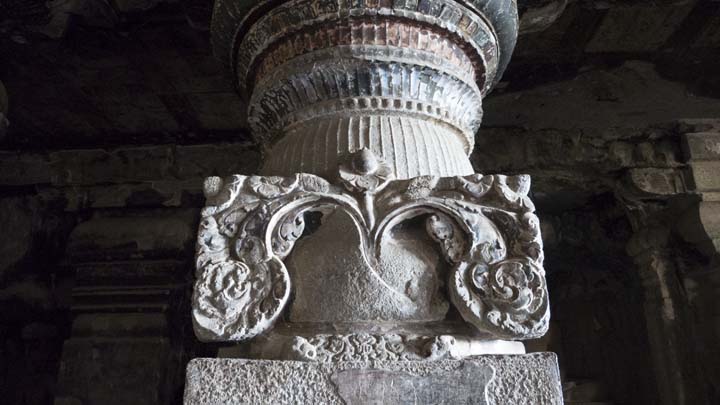
Indra Sabha is actually a collection of shrines dedicated to the revered Mahavira, the 23rd tirthankara .
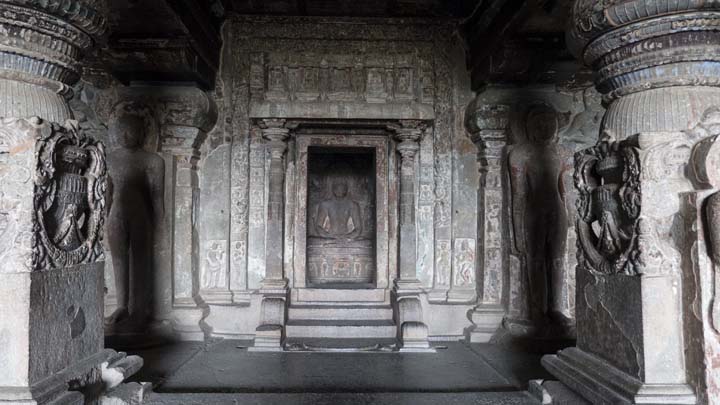
Mahavira (ca. 540-468 B.C.E.) was a contemporary of Buddha. The two had remarkably similar experiences and teachings. Like Buddha, Mahavira was born into a royal family. At the age of 30, he left his home in pursuit of spiritual awakening. Through ascetic practices for over twelve years, he achieved enlightenment. He traveled all over India for another 30 years to teach his philosophy, based on ahimsa (causing no injury through one’s deeds, words, or thoughts–which corresponds to Buddhist notions of body, speech, and mind); satya (absolute truth, like Buddhist right view); asteya (not stealing, or as Buddhists phrase it, not taking what is not freely given); brahmacharya (spiritual study, practice, and abstinence, similar to Buddhist monastic vows); and aparigraha (non-grasping or non-possessiveness, which forms part of the Buddhist idea of non-attachment and egolessness.) Mahavira attained nirvana after his physical death at the age of 72.

Jain depictions of Mahavira are also remarkably similar in appearance to Buddhist images of Buddha. With one key difference: Jain deities of the Digambara sect are nude.
When I saw Mahavira in an inner sanctum, I must admit that I was a bit surprised by the anatomical accuracy of his nudity. (The sacred art tells it like it is!)
But it’s not only Jain deities. The yogis, too. It reminded me of an anecdote the Dalai Lama told, and it goes something like this:
Once, at a ceremony in India, he found himself seated next to a Jain yogi who was stark naked. The Dalai Lama, shocked, had looked him up and down. “He just showed—everything! All of his things were right there!” He couldn’t help but keep looking at the yogi, but not because of his “thing.” Because he was so impressed with the intensity and forthrightness of this man’s practice! And so, the Dalai Lama got down on his knees and touched his forehead to the yogi’s knee as a sign of respect for him and his dedication to contemplative practice.

Pictured above is the revered Gomateshwara, also known as Bahubali.

Below is the 23rd tirthankara, Parsvanatha, with his characteristic snake hood.
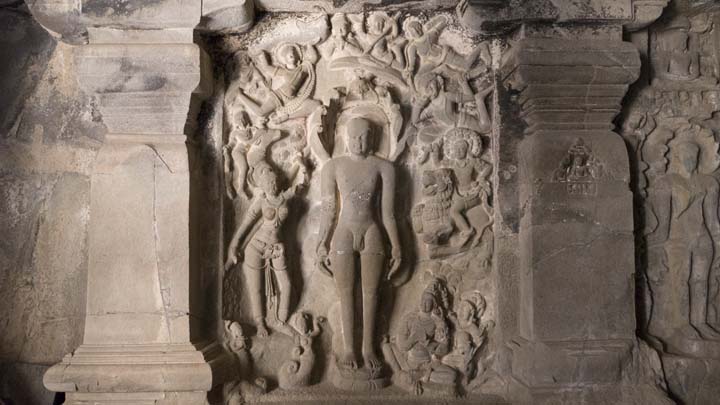
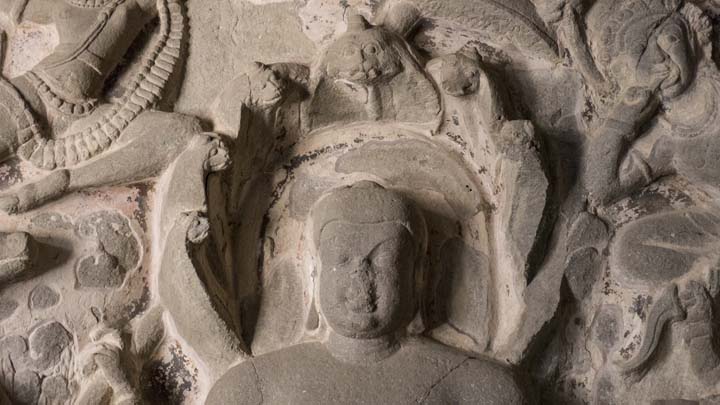
Mahavira is usually flanked by his attendant deities, Indra on an elephant and Ambika on a lion. I found these two carvings especially well done.

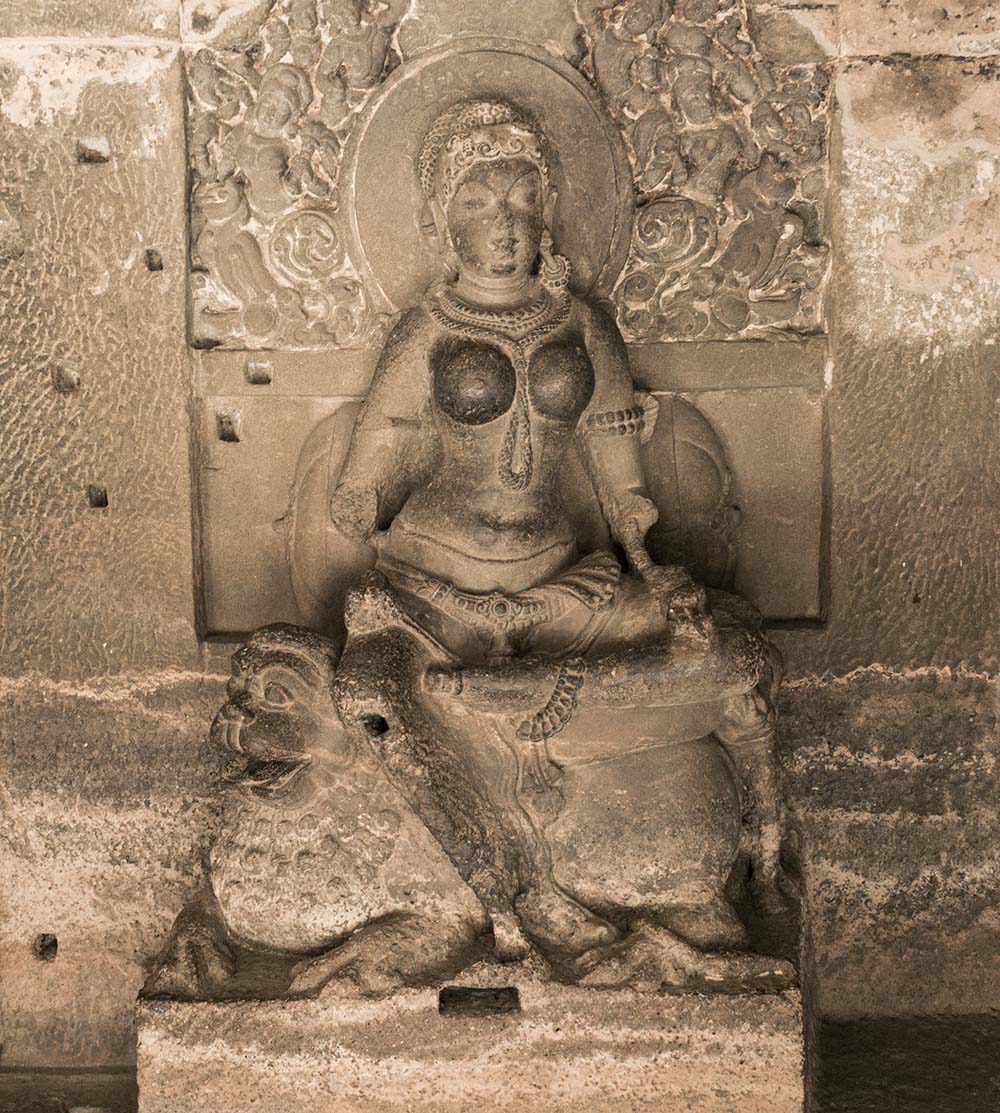
So there you have it…Ellora Caves–what a revelation in artistic and architectural excavation!

All photos © 2013, Eva Lee.
Strange though it may seem, the head of the All India Hindu Mahasabha insists that showing in public is against culture. Has he been to the various caves and temples across the length and breadth of India that show nudity and sex engraved in the very walls and pillars of the structures? Or is he pretending that all that is in Western lands?
Dear Friend,
The Hindu culture shown on these reliefs are quite different from contemporary Hindu culture, I can sense a clear difference in worship patterns and deities worshipped today. You don’t see Hanuman or Rama who are venerated today. This quite different, but one can say that Hindu culture in its ancient times was more open than today.