September 14th continued…Shashur Monastery…
By now, it should come as no surprise that the grandeur of the view at every monastery is a given, but I promise you, nature still just smacks you dumb with awe like the nicest bully you’ve ever had the fortune to meet!

The magnificent scale of the Himalayan landscape, the distance as far as your eye can see but which your mind can’t fathom, the lighting! You can see the same view over and over, and yet at different times of day, it’s as if you’re facing a new expanse, a different space. And while you’re in a car traveling, the changing vantage points as you wend your way on hairpin turns and switchback roads just leaves you idiotic with glee as you inhale all the sights to full capacity.
Shashur Monastery, like Tayul, is just a few kilometers away from Keylong. That’s why it was doable to see both on the same day.


Shashur and its contemporary flourishing Tayul and Gemur monasteries were part of a 17th to 18th century height of new Drukpa centers of Zanskar, Ladakh, and Druk Yul state of Southeastern Tibet (what is now Bhutan, the Buddhist country with a gross national happiness index.) This period was a spiritual revival of Drukpa masters coming to Lahaul on pilgrimage, such as Dewa Gyatso, Taktsang Repa, who founded the great Hemis Monastery (Ladakh), Rangrik Repa, and Serzang Rinchen who built Tayul.
The monastery has three floors and as you enter the ground level temple, you find a shrine with numerous spiritual personages. Front and center is the great Mahasiddha Drubchen Dewa Gyatso, revered founder of Shashur in early 17th century. He was from Zanskar.

Now there is this little holy statue of him that has a miraculous hat. It is said that monks on occasion come into the temple in the morning to find the guru’s hat mysteriously lying on the floor many feet away.

This is understood as a warning sign of trouble to come, issued out of the master’s compassionate spirit. Images of master Taktsang Repa have also been separated from his hat by virtue of this same phenomena. Similar miracles reported in Tibet were also taken as alerts to disasters such as famine, war, or epidemic.

There is also Shabdrung Ngawang Namgyal (1594-1651), great lineage holder, 2nd incarnation of 4th Gyalwang Drukpa, and founder of Druk Yul state in the 1640s. In the 1670s lamas of Shashur and Gandhola built relationships with this new Drukpa state which had enduring effects on Lahaul. To this day, there are deep spiritual ties between Garsha and Bhutan. Gandhola is still administered through Bhutanese lineage. It is Khandro Thrinlay, whom I met in Manali (see earlier post) who is presently looking after the preservation of Guru Ghantal. She holds the dual distinction of hailing from the Shakya Shri lineage as well as being the widow of the royal Bhutanese Drukpa spiritual leader, His Holiness the 9th Shabdrung Ngawang Jigme.
Whew, so much discussion about lineage holders often leaves a Westerner cross-eyed with provenance, but one has to remember that in esoteric spiritual teachings, the guru-disciple relationship is key because it’s transmitted orally and personally. Genuine teachings must come from authentic masters who can trace their roots back to prior authentic masters. It’s the branches-stemming-from-the-trunk idea.
While the sculptures in the shrines are carefully tended to, the paintings on canvas in this temple are rather loosely tacked onto the walls. It appears that some have become sooty, probably from years of incense burning, and attempts to clean them have left a number of the paintings smudged.


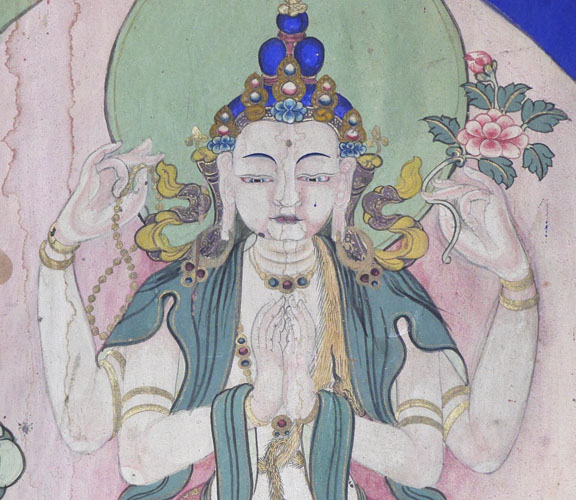
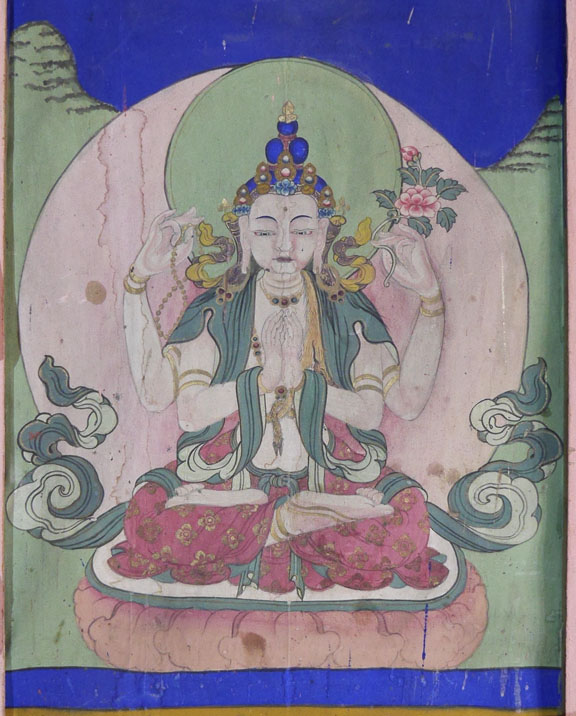
On the second floor of Shashur is a larger shrine room with statue of Vajradhara, the primordial Buddha, and paintings of the 84 Indian Mahasiddhas, main mahasiddhas of the Drukpa lineage, and great gurus and yidams.

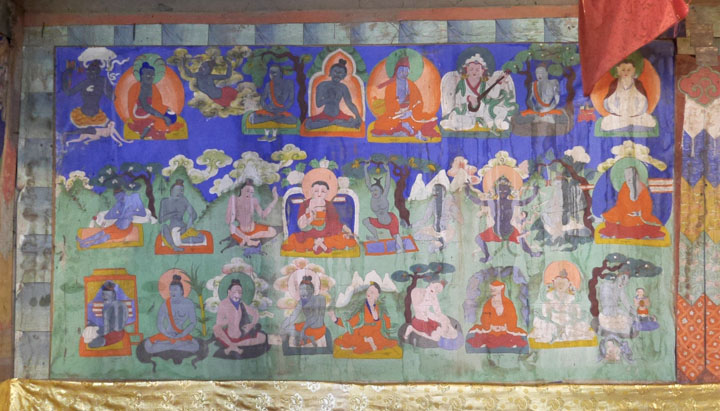


With full respect for the content, I’m sad to say that as a visual artist I find the wall paintings in Shashur (as well as Tayul) aesthetically unremarkable. Well, as I was forewarned by a local, Lahaul is not really a place for incredible paintings or visual depictions of mandalas as it is for visceral yogic experience in the land and spiritual centers.
Much more interesting than the painted mahasiddhas on the second floor walls were the statues flanking Vajradhara. One was Chakrasamvara and consort Vajrayogini or Vajavahari, and the other identified as Red Chakrasamvara. Both were most unusual in style and completely unconventional in terms of proportion. They do not look like Tibetan renditions of the deities and their consorts.


Shashur’s third floor temple was built by Lama Sonam, a disciple of Shakya Shri, in the 20th century during a spiritual revival of the time. Its altar features a statue of Padmasambhava.

While it was not happening during my visit, it bears mentioning that Shashur is well-known for its annual sacred cham dance which occurs in June or July. Visitors come from all over to witness the three-day rituals that culminate in cham performance. As a ritual, it is not to be seen and received as entertainment but rather as spiritual elevations transmitted to the audience as movement and gesture. Here is one that was performed when I visited Key Monastery in Spiti.


All photos © 2013, Eva Lee.
Wonderful to discover these posts, Eva.
The statue is not Mahadev with Uma, but Red Chakrasamavara in union. A special practice of the Drukpa lineage as transmitted by Drubwang Shakya Shri, who discovered a terma of that. So, nothing so curious, a speciality common in Garsha. Next time you have a doubt, don’t hesitate to ask…
Best wishes
Hello Ani-la, thank you for reading and for clarifying! I will correct in the post. Best wishes!