October 23, 2013
Going to Palpung Sherabling Monastery in the foothills of the Indian Himalayas was a revelation. Three years ago, when I first visited I had happily stumbled upon resident monks rehearsing their famed Lama dances, held bi-annually in the courtyard. This time, however, I was riveted by another aspect of this Karma Kagyu lineage of Tibetan Buddhism which I had not seen before.
It was the treasure trove of 3D mandalas on its mezzanine level. Because they were not visible from the ground floor of the main temple, I missed them last time. This time, I traveled with a senior monk who asked for access to other areas of the temple with art interest, and was therefore taken up to the mezzanine. Wow, fourteen 3-dimensional mandalas of the tantras of Marpa! Usually, if one is lucky enough to come across any 3D wooden models, one sees only one or two of them at a time. Here were fourteen of them, of such variety and fine quality, too!
So allow me to walk you through how I saw these mandalas.
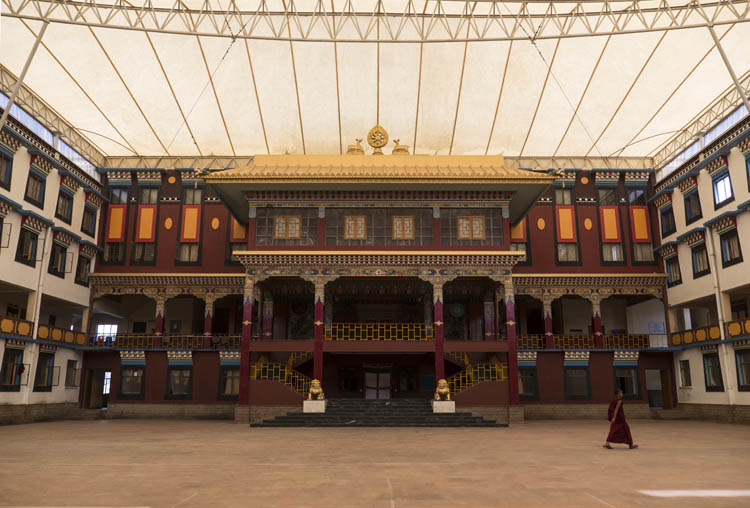
Here’s a view of Sherabling Main Temple and the inner courtyard. Very quiet that day, compared to the first time I saw it completely filled with monks dancing in organized circles.
Upon entering this well-appointed temple, you behold a 42-foot tall golden Maitreya, the future Buddha, seated on a throne beautifully gilded and elaborately decorated with filigree motifs.


In fact, this whole main assembly hall is exceptionally ornate with its painted and gilded columns, cornices, thangkas and friezes.
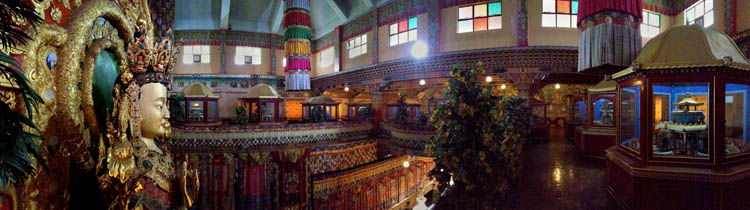
What is not visible when you stand on the ground floor is the spacious and tall mezzanine level above that houses the exquisite Mandala Shrine Hall. Here are some views of it.


And here’s a full view of this magnificent, monumental statue of Maitreya.

Himachal Pradesh, India
Notice that at the foot of the statue are photos of His Holiness the 14th Dalai Lama on the left, and His Holiness the 17th Gyalwang Karmapa on the right. The Dalai Lama is the spiritual leader of Tibetans and all Tibetan Buddhist schools, of which there are mainly four–Nyingma, Kagyu, Sakya, and Gelug. The Karmapa is the spiritual leader of the Kagyu school.
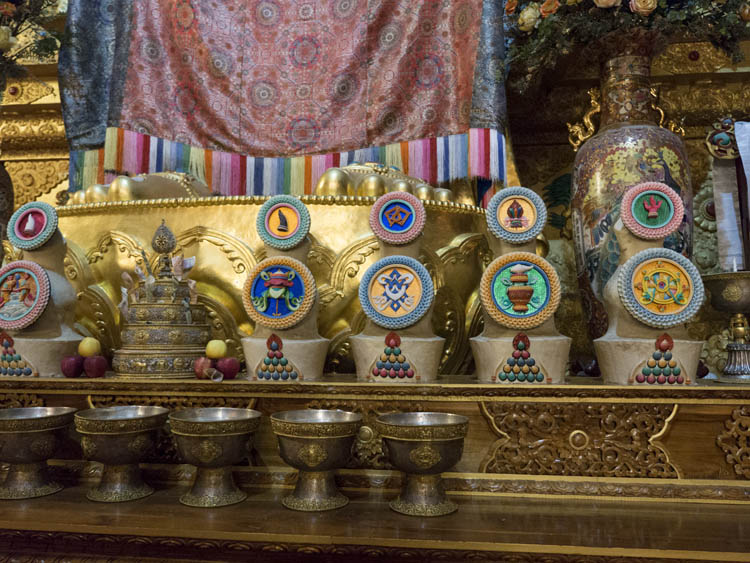
Now about the Mandala Shrine Hall, it displays wooden three-dimensional mandalas of the 14 tantras of Marpa. These are the main practices of the Palpung Sherabling (Kagyu) community.

Marpa (1012-1097 CE) was a great teacher and translator. In fact, one of his students became the first Karmapa. This is no small deal since the present Kagyu school’s Karmapa is the 17th incarnation, an older lineage than the Gelug school’s 14 Dalai Lamas. But perhaps, arguably, Marpa’s most famous student was Jetsun Milarepa (ca. 1052—ca. 1135 CE). How Milarepa became enlightened is an inspiring story of redemption.
As a layman, Milarepa had a dark personal history. He learned sorcery and exacted revenge upon an aunt and uncle who mistreated and took all of his family’s wealth upon the death of his father. As a result, Milarepa killed dozens of people through conjuring devastating hailstorms. Later, remorseful for his black deeds, he sought a teacher for help. That teacher turned out to be the fearsome Marpa, whose gaze was said to bely such inner power that people found it difficult to look at or be near him.

Marpa was apparently the right teacher for the destructive Milarepa to atone himself. He put him through arduous tasks, such as instructing him to build buildings, each time promising to teach him if he completed his request. However, Marpa repeatedly anguished and disappointed his hapless student by refusing to teach him sacred Buddhist practices. Despite building and tearing down three whole structures, and suffering much physical pain, Milarepa still did not received a single tantric oral transmission.

Milarepa was then asked to build a multi-story tower by Marpa at Lhodrag, where to this day the 11th century tower still stands. For a detailed telling of Milarepa’s trials and tribulations, see this Kagyu site.
When at last Marpa bestowed the spiritual teachings on Milarepa, his dedicated student then left to practice. After twelve years, he attained the state of Vajradhara (complete enlightenment).
Milarepa became a renowned ascetic and poet, a mahasiddha who lived in a cave in Namdaking, Tibet near the border of present day Nepal. He was said to have survived on nettles, an herb which caused his complexion to turn green. He is often portrayed in paintings with green skin tones for this reason. The other identifying aspect is his hand held to his ear. While it looks like a gesture of listening, I learned from a Tibetan nun that it is a yogic posture for affecting subtle energies of the body.

© 2007, Dru-gu Choegyal Rinpoche.

As for the Mandala Shrine Hall, it is an exceptional collection and display of the 14 tantras of Marpa. While most mandalas, such as the below Mahamaya mandala, follow the conventional form of a three-story palace with four gateways facing the cardinal directions, with the main deity residing at center, and associated deities in the surroundings, encompassed by ritual symbols and elements, only the initiated Kagyu practitioner would truly be familiar with the mandalas and their practices.

Even for practitioners from other Tibetan schools, the mandalas may seem unusual, such as this one. I believe the below mandala is that of a Dakini.

All photos © 2013, Eva Lee.
Except where otherwise credited