September 8th A Return to Key Monastery
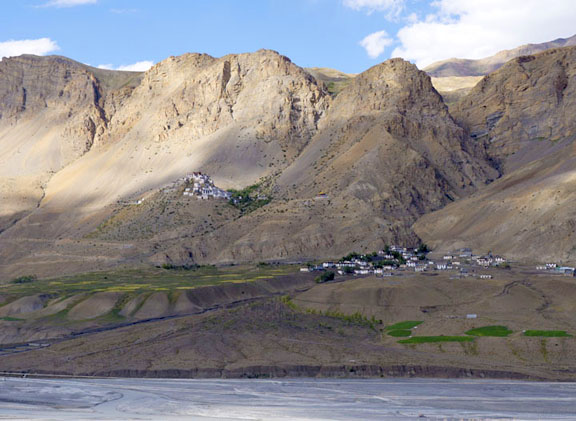
A second try today to document the ancient interiors of Key Monastery, whose abbot had in the 11th century been none other than The Great Translator Rinchen Zangpo himself, proved to be a challenge. However, in a nice turn of events, we discovered upon arrival that a special demonstration of sacred dances was in progress. The occasion was the visit of an important official from Shimla.

The main interior courtyard was filled with visitors and administrators, with the monastery abbot presiding over the ceremony, as junior and senior monks looked on.


A word about the architecture of Key…Built on a hilltop with a fortress appearance, this reflects typical Western Himalayan monastic architecture after circa 12th century, influenced by the development of invaders.

Earlier period structures such as late 10th century nearby Tabo Monastery and Alchi Monastery (in Ladakh) are located in the valley on flat open land, integrated with their villages. Invaders were oftentimes rival Buddhist sects supported by the might of the Mongolian military, such as the Sakya sect who headed Key Monastery in the 14th century, and the Gelugpa sect who headed it in the 17th century. The latter came to dominate the majority of monasteries in Spiti.
In fact, most of us don’t associate monastics with marauding, but post-12th century onwards, the region saw inter-sectarian clashes, conquering by bloodshed, innumerable invasions by Chinese and Mongolian forces, shifting power structures, and political unrest throughout the Western Himalayas. Thus, that illustrious period of refined Indo-Tibetan art and architecture under the guidance of Lotsawa Rinchen Zangpo and the collaboration of Kashmiri artists eventually came to an end.


All photos © 2013, Eva Lee.
wonderful trek Eva. I’m now email hooked in to your blog and traveling with you in spirit. Gracias…
Glad to have you along, Tom! Thanks!