Charmed at Lamayuru Monastery: Senge Lhakhang

September 22nd      Lamayuru Monastery – Part One

View of Lamayuru Monastery with village below, Ladakh, India
View of Lamayuru Monastery on plateau at top, with  Lamayuru Village below, Ladakh, India

Seeing Lamayuru Monastery today was a rich experience. The hilltop monastery complex is a delightful warren of small passageways that give way to open views. It includes the functional old, the relatively new, and then the crumbling ruins. Walking through it really imparts the feeling of a medieval village in its different stages of development and abandon.
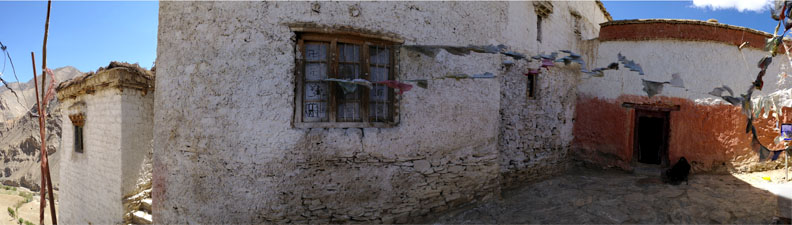
Senge Lhakhang, ca. 11th century, the oldest temple at Yamayuru Monastery. Contains well-preserved and rare Indo-Tibetan clay sculptures of Vairocana, Dhyani (Supreme) Buddhas, and Vajradhatu mandalas, including Gonkhang with protector deities, Ladakh, India

It’s an intimate temple. Upon entering, one faces the splendid and well-preserved altar which by now, dear reader following this blog, you will recognize as belonging to the rare Indo-Tibetan 11th century period of sacred art.

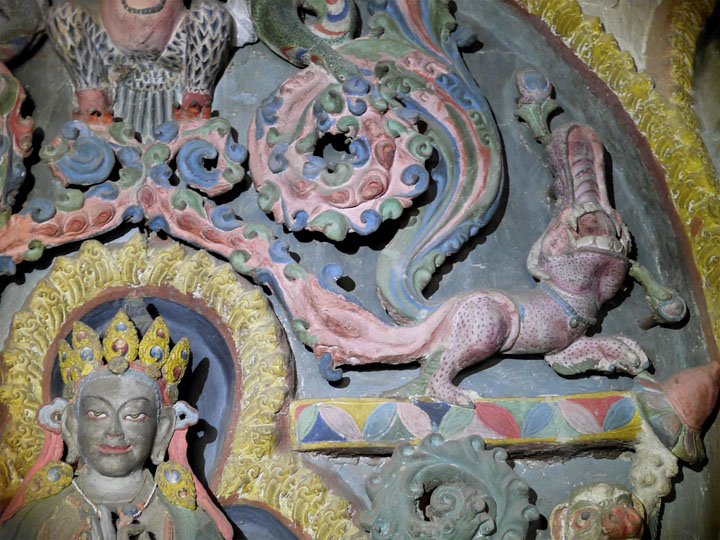
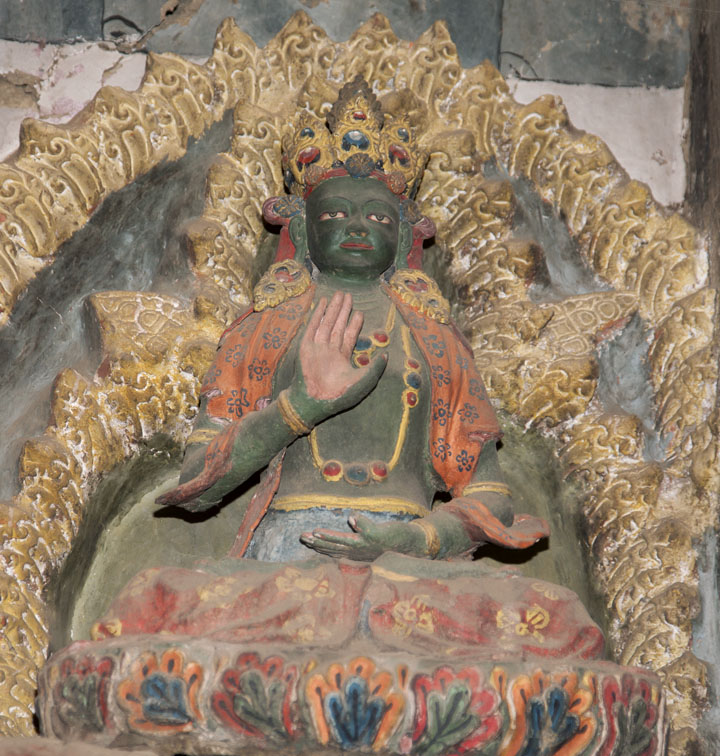
As at Lhalung and Tabo Monasteries, the temple features Vairocana and the Dhyani (Supreme) Buddhas Amitabha, Akshobhya, Amoghasiddha, and Ratnasambhava. These are polychromed clay sculptures seated on lotus thrones inside stylized alcoves. Here at Lamayuru, Vairocana is also seated atop lions which is how the temple derives its name. Senge means lion in Tibetan. He is surrounded by animals, scrollwork, and surmounted by a prominent protective Garuda, the powerful Hindu mythical bird.

Experience the interior of Lamayuru Monastery’s Senge Lhakhang by watching this exclusive video walk-through here.

[vimeo 137311083 w=600 h=337]
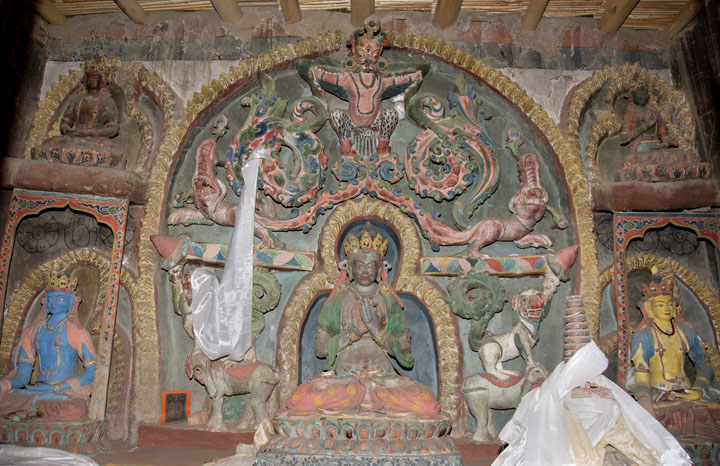
 

Main altar with central Vairocana, Lamayuru Monastery, Ladakh, India
Main altar, Senge Lhakhang, Lamayuru Monastery, Ladakh. Central figure is Vairocana, flanked by Dhyani Buddhas (clockwise from left) Aksobya (blue), Amitabha (red), Amoghasiddhi (green), and Ratnasambhava (yellow), surmounted at top by Garuda. Photo: Kishore Thukral
Indo-Tibetan clay sculpture of Vairocana, Buddha of Wisdom, one of the Five Dhyani Buddhas, Lamayuru Monastery, Ladakh, India
Indo-Tibetan clay sculpture of Vairocana, Buddha of Wisdom, one of the Five Dhyani Buddhas, main altar Senge Lhakhang, Lamayuru Monastery, Ladakh
Detail of main altar with central Vairocana surrounded by animals and surmounted by Garuda, Senge Lhakhang, Lamayuru Monastery, Ladakh
Detail of main altar with central Vairocana surrounded by animals and surmounted by Garuda, main altar Senge Lhakhang, Lamayuru Monastery, Ladakh
Ratnasambhava, one of the Dhyani (Supreme) Buddhas, main altar Senge Lhakhang, Lamayuru Monastery, Ladakh
Ratnasambhava, one of the Dhyani (Supreme) Buddhas, rare 11th century Indo-Tibetan clay sculpture, main altar Senge Lhakhang, Lamayuru Monastery, Ladakh
Detail of Vairocana Buddha and animals, rare 11th century Indo-Tibetan clay sculptures, main altar Lamayuru Monastery, Ladakh
Detail of Vairocana Buddha and animals, rare 11th century Indo-Tibetan clay sculptures, main altar Senge Lhakhang, Lamayuru Monastery, Ladakh
Detail of Akshobya, one of the Dhyani (Supreme) Buddhas, 11th century Indo-Tibetan clay sculpture, Lamayuru Monastery, Ladakh
Detail of Akshobya, one of the Dhyani (Supreme) Buddhas, 11th century Indo-Tibetan clay sculpture, main altar Senge Lhakhang, Lamayuru Monastery, Ladakh
Akshobya, one of the Dhyani (Supreme) Buddhas, 11th century Indo-Tibetan clay sculpture, Lamayuru Monastery, Ladakh
Akshobya, one of the Dhyani (Supreme) Buddhas, 11th century Indo-Tibetan clay sculpture, main altar Senge Lhakhang, Lamayuru Monastery, Ladakh
Amoghasiddha, one of the Dhyani (Supreme) Buddhas, rare Indo-Tibetan clay sculpture, main altar Senge Lhakhang, Lamayuru Monastery, Ladakh
Amoghasiddha, one of the Dhyani (Supreme) Buddhas, rare Indo-Tibetan clay sculpture, main altar Senge Lhakhang, Lamayuru Monastery, Ladakh. Photo: Kishore Thukral
Amitabha, one of the Dhyani (Supreme) Buddhas, rare Indo-Tibetan clay sculpture, main altar Senge Lhakhang, Lamayuru Monastery, Ladakh
Amitabha, one of the Dhyani (Supreme) Buddhas, rare Indo-Tibetan clay sculpture, main altar Senge Lhakhang, Lamayuru Monastery, Ladakh. Photo: Kishore Thukral
Detail of rare Indo-Tibetan clay sculptures, main altar Senge Lhakhang, Lamayuru Monastery, Ladakh
Garuda, Hindu mythical bird, main altar Senge Lhakhang, Lamayuru Monastery, Ladakh
Detail of rare Indo-Tibetan clay sculptures, main altar Senge Lhakhang, Lamayuru Monastery, Ladakh
The lions or Senge, main altar Senge Lhakhang, Lamayuru Monastery, Ladakh

In stark contrast to the fine state of the sculptures, the wall murals are in a very deteriorated condition, faded and water-damaged. In fact, facing the altar, the whole right side wall is altogether undecipherable, almost completely devoid of the original imagery. Looks blackened and/or delaminated down to the mud bricks. It’s incredible that after over one thousand years of time, anything can remain at all, really. Time has really ravaged this wall. I wish it were different!

The left hand wall can still be glimpsed. If only some effective and accurate conservation could be done to preserve these historically significant, rare examples of Indo-Tibetan Buddhism and the Second Transmission of Buddhism from India to Tibet!

Vajradhatu Mandala, Indo-Tibetan wall painting, Senge Lhakhang, Lamayuru Monastery, Ladakh

While it’s difficult to see details of the above wall painting, it is certainly a Vajradhatu Mandala and as such, its structure is usually this:

At center is Vairocana with the 4 Dhyani Buddhas (Amitabha, Akshobhya, Ratnasambhava, Amoghasiddha) positioned around him in the cardinal directions, each encircled by 4 bodhisattvas. There are an additional 12 deities–4 guardians, 4 outer offering goddesses, and 4 inner offering goddesses. In all, the basic set of Vajradhatu mandala deities is 33 or 37. Vajrayana mandalas and the deities that reside within them are essentially symbols of the qualities of consciousness to develop on one’s spiritual path. They are mnemonic devices to aid a practitioner towards enlightenment.

Variations in Vajradhatu mandalas are seen in different monasteries with the addition of up to 60 other divinities–such as the 16 arhats or 12 pratyekabuddhas, among others. These are often depicted on the outer sections as additional circles or squares in the same mandala composition, or in altogether separate small mandalas.

It is important to note that such symbolic plenitude expresses manifestations of the same fundamental principles. Buddhism did inherit the Hindu understanding of many-paths-to-the-same-truth. These additional divinities also have their basis in written scripture or canonical commentaries.

Avalokiteshvara (Chenrezig), bodhisattva of compassion, Indo-Tibetan wall painting, Senge Lhakhang, Lamayuru Monastery, Ladakh

Adjoining the main temple room is a gonkhang, chapel dedicated to protector deities.

Protector deities, including Mahakala and Lhamo Palmo, Gonkhang, Senge Lhakhang, Lamayuru Monastery, Ladakh
Protector deities, including Mahakala and Lhamo Palmo, Gonkhang, Senge Lhakhang, Lamayuru Monastery, Ladakh. Photo: Kishore Thukral
View of Senge Lhakhang, with Indo-Tibetan sculptures and wall paintings, Lamayuru Monastery, Ladakh, India
View of Senge Lhakhang, with Indo-Tibetan sculptures and wall paintings, Lamayuru Monastery, Ladakh
At the entrance of Senge Lhakhang, Lamayuru Monastery, Ladakh
Conversing with Kagyu monk at entrance of Senge Lhakhang, Lamayuru Monastery, Ladakh. Photo: Kishore Thukral

Lamayuru grounds in this older section near the Senge Lhakhang is characterized by these passageways that are alternately nestled and enclosed, then open and expansive.

Walking through older parts of Lamayuru Monastery, Ladakh
Walking through older parts of Lamayuru Monastery, Ladakh. Photo: Kishore Thukral
Walking through older parts of Lamayuru Monastery, Ladakh
Walking through older parts of Lamayuru Monastery, Ladakh. Photo: Kishore Thukral
Walking through older parts of Lamayuru Monastery, Ladakh
Walking through older parts of Lamayuru Monastery, Ladakh. Photo: Kishore Thukral
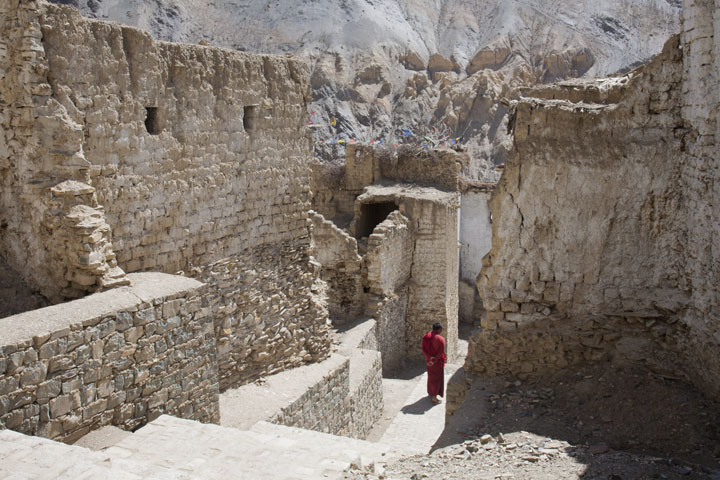
Walking through ruins of of Lamayuru Monastery, Ladakh
Walking through ruins of of Lamayuru Monastery, Ladakh. Photo: Kishore Thukral

Among the stone ruins, amidst the Himalayan landscape, I tried to imagine the charming bygone era of great vitality during the reign of Western Tibet’s Guge kings Yeshe O’d and Changjup O’d whose vision reformed and ignited the spread of Vajrayana Buddhism from India to Tibet in the 10th to 12th centuries. How it must have been in this remote Himalayan landscape a thousand years ago, when these walls and buildings were new, its monastic and lay inhabitants filled with rejuvenated fervor and scholarship!

Walking through older parts of Lamayuru Monastery, Ladakh
Walking through older parts of Lamayuru Monastery, Ladakh. Photo: Kishore Thukral
View of Himalayan valley from Lamayuru Monastery, Ladakh
View of Himalayan Village and valley from Lamayuru Monastery, Ladakh

All photos © 2013, Eva Lee.

Leave a Reply

This site uses Akismet to reduce spam. Learn how your comment data is processed.