September 14th Lahaul adventure continues…

Today was Shashur and Tayul Monasteries. Both are not far from Keylong, just several kilometers away. Tayul Monastery was founded in the 17th century, but like Kardang Monastery, little appears to remain from its original period. The current main temple was renovated in the 19th century. Probably the oldest objects to be seen are the ancient stupas one encounters en route, on the hike up to the site.
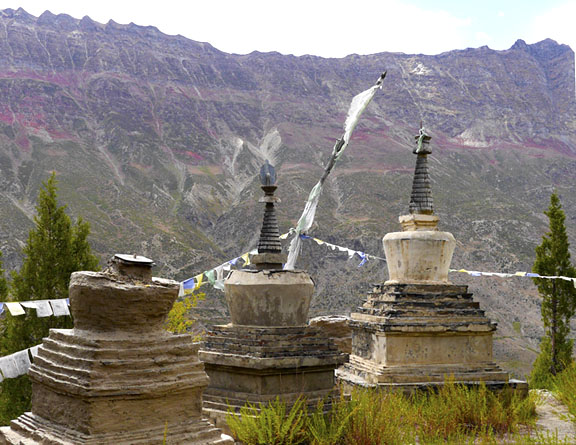
It must be reached on foot because there is no motorable road off the main road. The hike up is beautiful, of course, for its vistas. I was glad driver D accompanied me up because the trail is not so clear in some places. Locals do always advise having a guide. I still get winded doing the slightest incline up but hopefully each day will get better as I continue to acclimate to high altitude.
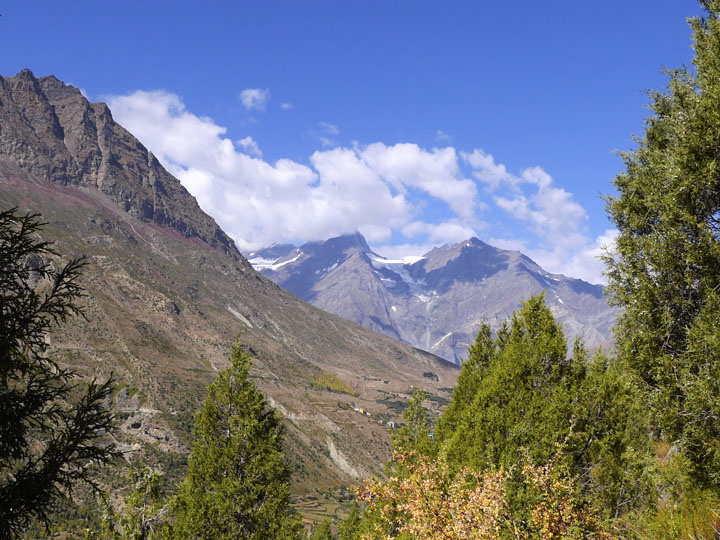
Directly opposite is sacred Drilbu Ri mountain. You can always spot it by looking for those seven little peaks in a row that lead to a notched area where one treks up and over to reach the summit.


In fact, the story goes that Tayul, which means “chosen place,” was a location noticed by founder and Drukpa yogi Serzang Rinchen when he made his pilgrimage up Drilbu Ri. From across the Bhaga Valley, after a meritorious kora around the mountain, he saw the site and decided to build a hermitage there which became Tayul Monastery. Upon entering the main temple, one sees the 12 foot statue of Padmasambhava (Guru Rinpoche), revered as a great sage and living Buddha by Tibetans for introducing Buddhism to Tibet in the 8th century, displaying miraculous feats in taming local spirits in the process. Flanking him at the altar are statues of Dakini Singha Mukha, and the wrathful emanation of the guru.


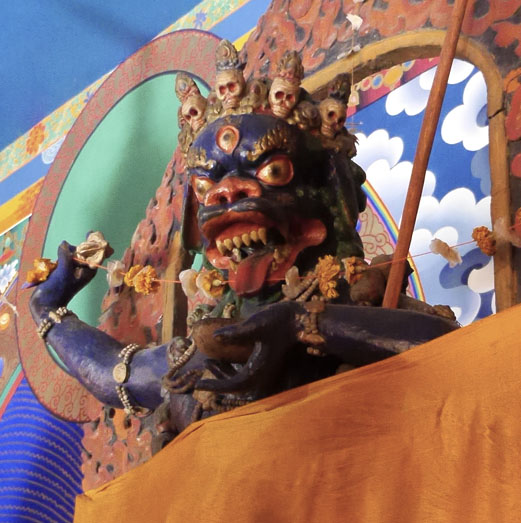
The original wall paintings from the 19th century by Lama Tashi Temphel, who stayed there and helped expand the monastery, are no longer extant. In its place are new paintings. Unfortunately, I found these contemporary-styled depictions rather stiff in execution, and less refined than older wall paintings I have seen to date in previous monasteries. Lama Temphel also made sacred images at Guru Ghantal Monastery, which happily can still be seen there. It had been suggested to me that Lahaul is not so much a place to find ancient Indo-Tibetan artwork, nor exquisite old wall paintings or mandalas even, as it is a place to be experienced physically as a land of yogi training, legend, and pilgrimage. So far, so true.


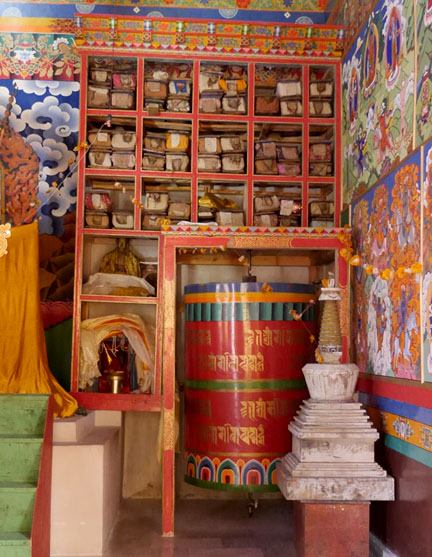
Tayul Monastery contains a complete Kangyur library and a large mani wheel that contains thousands of prayers. When spun, its blessings are activated and multiplies. According to its lamas, this wheel has been known to spin by itself on certain special occasions.
The British-born Tibetan Buddhist nun Tenzin Palmo was one of the first Westerners to encounter high Tibetan lamas in the early 1960s when she first arrived in India. She lived at Tayul for six years before retreating to a cave above it for twelve years. I read her biography Cave in the Snow like it was a suspense-thriller. I found her story and existential experiences riveting. It was a page-turner. Her retreat was abruptly interrupted by immigration authorities. Thus began her exit from solitary yogic practice to being a teacher in the world, a living example of Western and female accomplishment on the dharma path.
I always think that one beneficial outcome of the Tibet situation post-1959 is the creation of a diaspora which has lead to the spread of Buddhism in the Western world.
I saw Shashur Monastery the same day as Tayul. More to come!
All photos © 2013, Eva Lee.